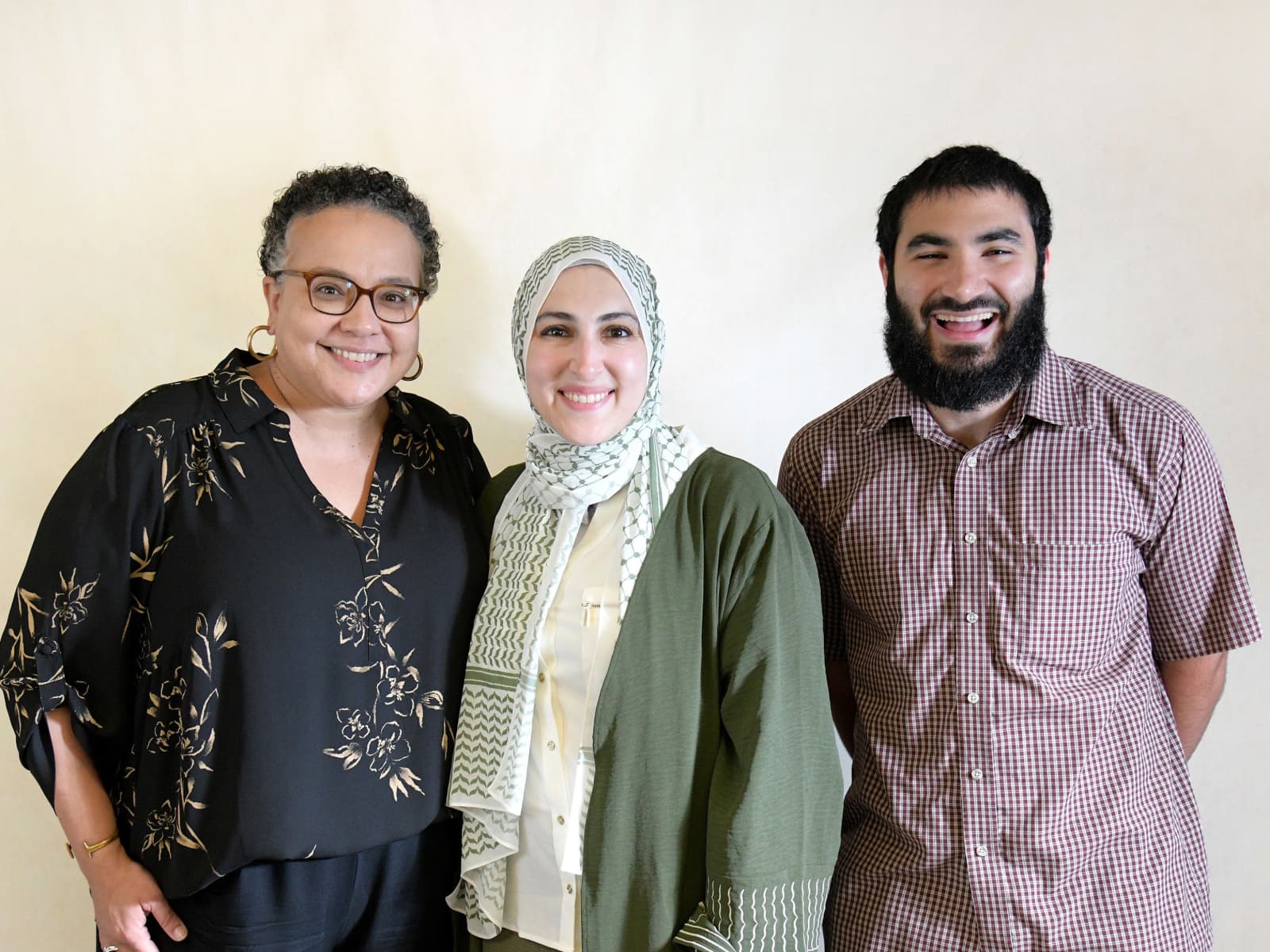
الراوي Denna Hantuli · أجرى المقابلة Farah Al-Nakib, Iyad Jamaly · تاريخ التسجيل 25 يوليو 2025 · المدة 1:50:12 · اللغة الإنجليزية
[00:00:00] Farah Al-Nakib: Okay. So, this is an oral history interview for Mawtini Arab American Narratives of Home and Belonging oral history project. I'm Farah Al-Nakib. I'm here interviewing with my fellow co-interviewer...
[00:00:16] Iyad Jamaly: Iyad Jamaly.
[00:00:17] Farah Al-Nakib: And we are interviewing Deena Hantuli. It's July 25th, 2025, and we're at the Cal Poly campus. Deena, can I just have you say and also spell your name for us, please?
[00:00:28] Deena Hantuli: Yes, my name is Deena, D-E-E-N-A. Last name is Hantuli, H-A-N-T-U-L-I.
[00:00:37] Farah Al-Nakib: Perfect. So, to begin, I just want to ask you, so what is your origin? Like, what's your family background?
[00:00:41] Deena Hantuli: Palestinian, both sides. My mom and dad, both Palestinian. They were born in Palestine, but they were raised in Kuwait their whole life because, as you know, when Israel took over, there were, many Palestinians had to leave, and that's how my family ended up in Kuwait.
[00:00:59] Deena Hantuli: My grandparents, may they rest in peace, they had to walk through the desert to get all the way to Kuwait, and that's where they had to establish and build their new life, and that's where my parents were raised. But they were both born in Palestine, so I'm Palestinian.
[00:01:16] Farah Al-Nakib: Where, where were they each born? Like, which part of Palestine were they
[00:01:20] Deena Hantuli: from?
[00:01:20] Deena Hantuli: The West Bank. It was an area in the West Bank. They were both there. It's called Silat al-Dhahr. That's between, it's closer to Jenin. It's between Jenin and Nablus, but closer to Jenin.
[00:01:34] Farah Al-Nakib: And so they were both born there. Yes. And when did, so, did they leave in 1948, or?
[00:01:44] Deena Hantuli: No, no, no. After, yeah. No, no, no, after. It was after '67.
[00:01:47] Farah Al-Nakib: After '67. Yes. So they were still in, the West Bank the whole time.
[00:01:52] Farah Al-Nakib: Yeah, but you know, Israel
[00:01:53] Deena Hantuli: controlled everything. And there were very few choices left, so that's why a lot of people, especially from the West Bank, a lot of people ended up in Kuwait or in Jordan. We ended up in Kuwait.
[00:02:04] Farah Al-Nakib: Do your parents, did they ever talk to you about their own lives growing up in the West Bank?
[00:02:10] Deena Hantuli: Oh, yeah.
[00:02:11] Farah Al-Nakib: And what that was like?
[00:02:11] Deena Hantuli: Oh, yeah.
[00:02:11] Farah Al-Nakib: Do you remember some stories or things they talked about?
[00:02:13] Deena Hantuli: So my dad would still tell us, like, I mean, my parents were very, very little when they left, but my dad would still tell us, like, some stories, like when, he'd tell us like, oh, you know, they had fields, or they had, you know, they grew fruit, or they, you know, they had, like, animals.
[00:02:29] Deena Hantuli: He would still tell us those stories. My grandma, for example, may she rest in peace, she would always tell us those stories how the field, they would actually, you know, plow the fields and grow it, and they had, you know, in 'Araby we call it, you know, basateen w mazaare'. And it was always a dream to one day go back.
[00:02:48] Deena Hantuli: Ever since I was little, little, I mean, I remember my dad would always tell us, like, "Inshallah, when Falastin comes back, we're gonna go live there. When Falastin comes back, we're gonna go live there." I mean, it's hard to imagine it would come back one day, but that's still my, my hope too. I still say every day, "If Falastin comes back, I'm out of here. I'm gonna go back and live there." It's, it's homeland. Yeah. I've never been there, but still feel that's the homeland.
[00:03:18] Farah Al-Nakib: So did they, they both live through the '67 war?
[00:03:23] Deena Hantuli: So yes. Yes, they did.
[00:03:27] Farah Al-Nakib: But they were young.
[00:03:28] Deena Hantuli: They were very young.
[00:03:29] Farah Al-Nakib: You said they were very young.
[00:03:29] Deena Hantuli: Yeah. Yes.
[00:03:31] Farah Al-Nakib: Do they remember it at all?
[00:03:34] Deena Hantuli: I don't think I've asked them those questions, but I know they still remember, you know, there was no money. It was very harsh and, sometimes some people would just not even come back. They would die and just not even come home, and they wouldn't even know that would happen to them.
[00:03:51] Deena Hantuli: I know, like, I think it was a great-grandpa, for example, they said he, like, left one day and never came back. There's, even on my husband's side, he would tell, he recently told me, like, his dad, may he rest in peace too, disappeared for a very long time. Even though he was in Jordan, he went to fight during those wars, and he disappeared for the longest time.
[00:04:14] Deena Hantuli: So yeah, there's, there's still memories. When Israel came in, it's just harsh. It's harsh, and people suffered back then, and unfortunately, they still suffer today.
[00:04:27] Farah Al-Nakib: And so why did they end up going to Kuwait?
[00:04:32] Deena Hantuli: Because Kuwait was this up and starting small little country. There were... They heard there were job opportunities. You know, like the oil fields. Like, my grandpa worked, I believe he worked in KOC, which is the Kuwait Oil Company. So there were newer job opportunities, and that's why people went, because it was a country that was starting from the beginning.
[00:04:58] Deena Hantuli: Because, as you know, it was occupied as well. And, you know, the occupation kinda ended there, I wanna say. So it was starting out, so that's why people went there, to start a new life. So, like, from what I remember, because I was born there, almost everybody around us was Palestinian in Kuwait.
[00:05:15] Farah Al-Nakib: So both... So these are both your grandparents from your mom and dad's side.
[00:05:19] Deena Hantuli: Yes
[00:05:19] Farah Al-Nakib: That decided to move to Kuwait.
[00:05:21] Deena Hantuli: Yes.
[00:05:21] Farah Al-Nakib: And your parents were both kids. So they didn't know each other.
[00:05:25] Deena Hantuli: No.
[00:05:25] Farah Al-Nakib: Yet. And what were, what, so what were your grandparents, working as, like, on both sides? Did they, so you mentioned one.
[00:05:34] Deena Hantuli: My dad's side, I know he was working Kuwait Oil Company.
[00:05:37] Farah Al-Nakib: Okay.
[00:05:38] Deena Hantuli: My mom's side, I don't know, but he, I know he had a job maybe with a company. And that's what a lot of people did. They just had, like, you know, jobs here and there, and then they considered Kuwait as their new place to just live. And, you know, but in Kuwait you can't own anything, so that's why the dream was always when we go back one day. But nobody was able to. But, yeah, they lived in Kuwait, up until the Gulf War. That's when we moved here.
[00:06:04] Farah Al-Nakib: And you were born there.
[00:06:06] Deena Hantuli: I was born there.
[00:06:06] Farah Al-Nakib: What year were you born?
[00:06:07] Deena Hantuli: '84.
[00:06:10] Farah Al-Nakib: '84. So do you have memories of-
[00:06:12] Deena Hantuli: Oh, yeah.
[00:06:13] Farah Al-Nakib: What do you remember from the '80s in Kuwait?
[00:06:15] Deena Hantuli: Oh, god, we loved it. I loved it. We lived in a apartment. It was a big apartment. I remember there was, like, swimming pools downstairs. You had friends, you had family, ah, family all the time. And then just coming here and not having anybody, it was hard. Very, very, very hard.
[00:06:36] Farah Al-Nakib: Where did you live?
[00:06:38] Deena Hantuli: I think it was Fahaheel.
[00:06:40] Farah Al-Nakib: Oh, okay.
[00:06:41] Deena Hantuli: Yeah.
[00:06:42] Farah Al-Nakib: Do you remember what your neighborhood was like?
[00:06:46] Deena Hantuli: I remember we had, like, restaurants downstairs, Pizza Hut and whatnot. That's what I remember. I remember we would go downstairs to take the bus to school. Like I said, there were swimming pools. We had neighbors. It was, so the building we lived in, because my dad was a civil engineer, so he was, we lived in a building that I wanna say kind of sponsored by his company.
[00:07:09] Deena Hantuli: So we had people from all different backgrounds living there. We had, like, our neighbors were from Egypt. We had other neighbors that were, you know, maybe from Britain, I don't really remember. But I remember we had friends. They would visit us. We would visit them. It was fun times. It was good.
[00:07:25] Farah Al-Nakib: Where did you go to school? Do you remember your school?
[00:07:27] Deena Hantuli: Yes. So, for preschool I remember I went to a British academy, and then after that, I don't know, I just went to a private school because, I think my mom's fear was... I don't know, we just went to a normal other school. Think there was always, like, a fear, like, what if one day we can't afford these schools, you know?
[00:07:51] Farah Al-Nakib: It was a private Arabic school.
[00:07:54] Deena Hantuli: Arabic school. Yeah.
[00:07:54] Farah Al-Nakib: In the area, in Fahaheel, in that area? Or was it...
[00:07:57] Deena Hantuli: I don't remember, honestly. It was out there. I don't remember.
[00:08:01] Farah Al-Nakib: Do you remember, like, what you guys used to do for fun? You mentioned the building and the neighborhood, yeah.
[00:08:06] Deena Hantuli: Oh, yeah! So I remember the bahar, the beach wasn't that far. I could've swore you could see it from the window but I could be wrong.
[00:08:14] Farah Al-Nakib: No, in that area you can.
[00:08:15] Deena Hantuli: Okay. So then I was right. It wasn't far. It wasn't far at all. So I remember, like, when you wanted to have fun, you would go to the bahar, especially at night, because, you know, Kuwait is pretty hot, pretty warm.
[00:08:26] Deena Hantuli: You'd go at night, and there was a nightlife. You can buy, like, ice cream or there was a special ice cream mixed with, like, mango juice and fruit. I forgot what it was called, but food at night. It was just fun. There was a nightlife, and relatives, and good times. It was good times.
[00:08:46] Farah Al-Nakib: And so you had, yeah, so you had your families from both sides, from your mom's side and your dad's side, so did you have lots of cousins and...?
[00:08:53] Deena Hantuli: We did, but on my mom's side, unfortunately, when my grandpa passed away, he passed away pretty young. My grandma was still young. And in Kuwait, I don't know if it's, like, a sponsored visa, I don't know what you really call it, so when he passed away, they had to leave the country. And, alhamdulillah, they were able to secure, like, a visa to go live in Saudi.
[00:09:18] Farah Al-Nakib: Okay.
[00:09:19] Deena Hantuli: So my grandma had to leave with my two uncles to go to Saudi, where she had a brother, and my uncle was working as a doctor there, so they had to leave and go to Saudi. That's hard. So I still had, uh, my aunt on my mom's side, yes. And I had cousins. They were all boys at the time, so I was the only girl, and so I would get spoiled by her, and it was, it was a good time.
[00:09:45] Farah Al-Nakib: And you have, I know this, but you have sisters, right?
[00:09:48] Deena Hantuli: Yes.
[00:09:48] Farah Al-Nakib: So what are the age gaps between you?
[00:09:51] Deena Hantuli: So it's me, and then I have a brother. So me and him were born in Kuwait, and we went to school for, like, our first year or two. And then I have a sister. She was little. She didn't go to school at the time. And then one after her, and then a brother that was born here, and then a big age gap, the little sister came along.
[00:10:12] Farah Al-Nakib: So you're six total. So four girls, two boys.
[00:10:16] Deena Hantuli: Yes.
[00:10:16] Farah Al-Nakib: Okay.
[00:10:17] Deena Hantuli: Yes. So the first five, not too big of age gaps. Maybe, like, two years here and there, maybe three maximum, but the youngest one, no, there's, there's an age gap. So between me and her is about 16 years. Yeah.
[00:10:30] Farah Al-Nakib: Yeah. So the summer of 19... Well, before we get to that, did you used to stay in Kuwait over the summers? Did you used to travel growing up?
[00:10:43] Deena Hantuli: Yeah, we did, we traveled. So like, you know, I remember, one year maybe we went to Jordan. We used to come here to United States. Sometimes we would go to like Germany. I had cousins in Germany. So yeah, we, we used to travel. We used to travel.
[00:11:01] Farah Al-Nakib: Do you remember, the Palestinian community in Kuwait, I mean, how would you describe the community? Do you remember? I mean, I know you were quite young, but-
[00:11:10] Deena Hantuli: I was, I was young. It was relatives, a lot of relatives that we had, Palestinians. I want to say like, well, most of the relatives all lived in Kuwait. Maybe like for example, like out of my parents side, maybe like one aunt lives in Jordan.
[00:11:26] Deena Hantuli: So mostly everybody lived in Kuwait. It was good, it was good times. I mean, even went to school, it was diverse, like you might see like people from other places, maybe like, you know, Egypt or something. But I would say a lot of the students were Palestinian.
[00:11:45] Farah Al-Nakib: And the teachers?
[00:11:47] Deena Hantuli: Palestinian.
[00:11:47] Farah Al-Nakib: Yeah?
[00:11:48] Deena Hantuli: Yeah.
[00:11:49] Farah Al-Nakib: And this was, this would have been just for the, an all girls school.
[00:11:53] Deena Hantuli: Yes, it was an all girls school.
[00:11:54] Farah Al-Nakib: Yeah. And did you used to meet much or interact much with other communities, like with Kuwaitis or other groups? Or was it, did it tend to be quite-
[00:12:04] Deena Hantuli: I mean, I was young. I know like we interacted with our neighbors who weren't Palestinians. But my parents had Kuwaiti friends. Like, my dad had Kuwaiti friends who he's still in really good relationships with till now. Yes.
[00:12:21] Farah Al-Nakib: Do you remember where your dad worked in Kuwait? You said he was a civil engineer.
[00:12:23] Deena Hantuli: He was a civil engineer, yeah, kuwait Oil Company.
[00:12:26] Farah Al-Nakib: Oh, he was with Kuwait Oil Company?
[00:12:28] Deena Hantuli: Yes.
[00:12:28] Farah Al-Nakib: So he, and so his father was, and then he was too.
[00:12:33] Deena Hantuli: Yeah. Unless, I could have swore my grandpa also worked for Jetty? I forgot what it's called.
[00:12:38] Farah Al-Nakib: Getty Oil. Yeah.
[00:12:40] Deena Hantuli: Yeah. I could have swore he worked for that too, but my dad, from what I remember, he worked for KOC, Kuwait Oil Company.
[00:12:46] Farah Al-Nakib: Did your mom work at the time?
[00:12:47] Deena Hantuli: No. No, no, no. Yeah. She stayed at home.
[00:12:49] Farah Al-Nakib: Yeah. So did you wanna ask any questions about Kuwait?
[00:12:55] Iyad Jamaly: I was curious, going a little back, in the beginning you mentioned that your grandparents walked through the desert to get to Kuwait.
[00:13:02] Deena Hantuli: Yes.
[00:13:02] Iyad Jamaly: So how was that migration like, if you have any stories or anything?
[00:13:09] Deena Hantuli: I remember my, when we were growing up, like, my mom would always tell us that. She would always say, like, "Your grandpas both walked through the desert." Like, they both walked through the desert. But it really, really hit me, I don't know if you guys ever watched, it was a Syrian-made series. It aired maybe in 2004 or 2003. But they, they portrayed the Palestinian struggle. It was called "Al-Taghriba Al-Filistinia." I highly recommend for everybody to watch it. It's on Shahid. I'm not advertising for them. But, I remember there was a part there that showed them migrating through that desert, and how some of them didn't survive.
[00:13:53] Deena Hantuli: And that's when it, like, hit me. Because I was, I was an adult at the time, and I saw it and I was like, "Oh, my God, this is what my grandpas really did." And my mom and dad were like, "Yeah, this is exactly what your grandpas did, Allahyirhamhum." And, I know, like, one story my mom would always tell me is her uncle did the same thing.
[00:14:13] Deena Hantuli: And you know, they told him a lot of people didn't survive. It's, you're walking through the hot desert. She said, like, for example, if he sees a knafeh, he has to eat it. Like, he had to because he's still, he still remembers, I don't know, I think he, like, craved it or he saw it, but he couldn't get it, and it, like, still stuck in his memory.
[00:14:33] Farah Al-Nakib: While they were migrating or something, yeah.
[00:14:35] Deena Hantuli: Or something. But you know, you had no money, and it was the desert. And it was, it was tough times, but alhamdullah, they made it. But you have to remember, all these men did it on their own first, and left their families back there until they were able to bring them back to them later on.
[00:14:54] Deena Hantuli: So here you have men who are walking through the hot desert, and wives who are at home with their kids also struggling. You know, they're, they're struggling kinda like single moms. You know, they have their kids to take care of. And a lot of times... And they didn't have cellphones back then. You didn't have Wi-Fi.
[00:15:13] Deena Hantuli: Imagine you're sitting at home and you're, you don't know what has happened to your loved one, or your, it's just hard. I can't even imagine it. And man, they were tough. Like even, even growing up, you know, like their offspring, they didn't have it easy either. Because sometimes they weren't able to go to college, for example, in Kuwait, so they had to go to other countries.
[00:15:39] Deena Hantuli: Like, my dad was one of those people. He came here to go to school. That wasn't easy. You're, like, in the 1980, early '80s or, you know, late '70s, you're in places like Texas or Oklahoma where, I mean, racism is still there till now, so imagine back then, and you didn't have cellphones, you didn't have communication.
[00:16:03] Deena Hantuli: I mean, you were lucky if you, you know, were able to, like, write a letter or whatever. So they, they really, really had it tough. They really had it tough.
[00:16:12] Iyad Jamaly: So is that what your family, where your grandparents, both your grandpas went and then brought their families later?
[00:16:19] Deena Hantuli: Yes.
[00:16:19] Iyad Jamaly: And how, like, how did they bring them to Kuwait?
[00:16:22] Deena Hantuli: I honestly didn't ever really ask, but I'm thinking it wasn't through walking. Because that, later on. But yeah, that's where they were all raised, in Kuwait. And if you ask any single one of them, they still reminisce about those days.
[00:16:39] Farah Al-Nakib: So your dad, you mentioned went to, came, came to, went to the States to go to college?
[00:16:44] Deena Hantuli: Yes.
[00:16:46] Farah Al-Nakib: Where did he, he went to Texas, or?
[00:16:47] Deena Hantuli: At first, I think he went to Texas and then Oklahoma. So he was a Oklahoma State University alumni. He finished civil engineering but he never planned on living here. He went right back.
[00:16:59] Farah Al-Nakib: So he went right back to Kuwait.
[00:17:00] Deena Hantuli: Oh, yeah, yeah, yeah.
[00:17:01] Farah Al-Nakib: So were your parents married yet, or not?
[00:17:03] Deena Hantuli: No, no, no, not yet, no.
[00:17:04] Farah Al-Nakib: So this was, so they met after.
[00:17:05] Deena Hantuli: Yes, yes. Then they got married, and he never wanted to live here. Yeah. I don't blame him. But yeah, that's how, that's what happened. He went back there. And yeah, and then we came for vacations and stuff. And then...
[00:17:19] Farah Al-Nakib: Which, where would you go? Back to Oklahoma or...?
[00:17:22] Deena Hantuli: So they did, I know, like, they did road trips. I know one year my, from what I know, we still have, like, videotapes of it. I haven't watched it in a million years, if they still exist. They would go to, like, Oklahoma because my uncles were still there. And they would take, like, a road trip all the way from there to, like, California or vice versa. My grandparents would be here. My aunt and her kids. So it was, that's what we did. We did that a few times. Yeah.
[00:17:57] Farah Al-Nakib: But your mom had stayed in Kuwait the whole time, or did she also leave to study at any point?
[00:18:03] Deena Hantuli: No, no, no.
[00:18:03] Farah Al-Nakib: She stayed in, she was in Kuwait.
[00:18:04] Deena Hantuli: Yeah. She finished high school there.Yeah.
[00:18:06] Farah Al-Nakib: Yeah. Do you know how they met?
[00:18:08] Deena Hantuli: How? Family.
[00:18:09] Farah Al-Nakib: Family?
[00:18:09] Deena Hantuli: Yeah.
[00:18:10] Farah Al-Nakib: Yeah.
[00:18:10] Deena Hantuli: Yeah.
[00:18:14] Farah Al-Nakib: So then if we go to, we were speaking before off tape, but, the summer leading up to the Iraqi...
[00:18:22] Deena Hantuli: The war?
[00:18:23] Farah Al-Nakib: ...invasion of Kuwait. I mean, what, what do you remember about that summer? Even before we get to, like, you know, the, the morning of August 2nd. But do you remember, were you guys talking about it? Was there a sense that something was happening?
[00:18:35] Deena Hantuli: So what I remember, the day before, the day before it happened, I mean, I still remember what I was wearing that day before.
[00:18:41] Farah Al-Nakib: What you were wearing?
[00:18:41] Deena Hantuli: I remember it was, it was, like, a cute little, like, little nightgown pajama. It was, like, purple, and I was wearing it, and I was so happy with it. And my dad had a day off, you know, the next day, and we were watching TV, and then they said, "Go to sleep. We're gonna go out tomorrow." And then in the morning when we woke up, everything was different. It was totally different. My dad was glued in front of the TV.
[00:19:02] Deena Hantuli: The TV wasn't what we were used to anymore, because it was Iraqi TV. And then they said, "We're going, going to your, your grandma's. We're going to grandparents." We're like, "Okay." And then on the drive there you see tanks. And you see, you see a different world.
[00:19:18] Farah Al-Nakib: Is that how they knew that Kuwait had been invaded, by turning on the TV?
[00:19:22] Deena Hantuli: So the night, so while we were sleeping, we had, I had uncles that were here. I had two uncles that were still here. They called my dad.
[00:19:32] Farah Al-Nakib: In the States?
[00:19:32] Deena Hantuli: Yes. They were in California. They called my dad middle of the night, and they said, "Kuwait's getting invaded. Iraq is invading Kuwait." And he said, "What are you guys talking about?"
[00:19:44] Deena Hantuli: Like, and then he hung up, and he went to sleep, because he was like, "No, why are you guys bothering me? Like, what kind of talk is this?" And he went back to sleep, but you know what? They were right. And, you know, later on you, you start to think about it. "Hmm, how did Americans or America know about it while the people there didn't?"
[00:20:03] Deena Hantuli: Later on in history, you know, you find out why, but yeah, that's how, I mean, they warned us that night, but we didn't believe it.
[00:20:11] Farah Al-Nakib: And so he said, "Okay, we're going to your..."
[00:20:13] Deena Hantuli: Grandparents
[00:20:14] Farah Al-Nakib: ...grandparents' house." Where was that? Do you remember where they lived?
[00:20:18] Deena Hantuli: Oh, gosh, it was, I know the name, but I can't remember it. Al-Mahboula.
[00:20:25] Farah Al-Nakib: Oh, okay. So not too far away from where you were.
[00:20:29] Deena Hantuli: Al-Mahboula. Literally. There's, like, a highway there, and I remember they had a big window in their apartment. It was a huge window, and if you look out, you could see the freeway or the highway, whatever you call it. _Khat al-Saree' bil 'araby._
[00:20:41] Farah Al-Nakib: Yes, exactly.
[00:20:42] Deena Hantuli: And you could see all of these cars leaving, and they had like, everything packed, and people were leaving the country. Everybody was leaving the country.
[00:20:51] Farah Al-Nakib: Yeah, because the highway goes south.
[00:20:52] Deena Hantuli: Yep. Everybody was leaving the country. Everybody. Yeah, and you heard a few explosions here and there, but yeah.
[00:20:58] Farah Al-Nakib: So you were six.
[00:21:00] Deena Hantuli: Yes. Yeah.
[00:21:01] Farah Al-Nakib: Yeah, six. Do you, I mean, do you remember what that felt like? Like, going there and going on the drive and seeing it, did you really understand it?
[00:21:09] Deena Hantuli: It was, it was a weird, like, scary feeling because we've never seen tanks before, never seen soldiers like that before. It was, it was, I mean, your whole life changed upside down. So for example, I think from that day forward, we didn't go back, we didn't live in our apartment. Because like I mentioned earlier, our apartment had people from different countries, and a lot of these people went back to their countries.
[00:21:36] Deena Hantuli: Like, if you had people from England, they went back to England. You had people from Egypt. And also, it was summertime. So a lot of people don't stay in Kuwait in the summertime because it's extremely hot. So to live there by ourselves would've been kind of scary. So we did go back to our apartment a few times, and it wasn't, we found Iraqi soldiers in there.
[00:21:59] Farah Al-Nakib: Oh, really?
[00:21:59] Deena Hantuli: The first time, yes, the first time we went in there, there were Iraqi soldiers, and I still remember they held up a gun. I still remember that gun. They held up a gun to my, dad, and then, you know, my dad was like, "We live here." And they, they left. They didn't hurt us. They left.
[00:22:14] Farah Al-Nakib: They left the apartment?
[00:22:15] Deena Hantuli: Yeah, they left. And the second time, and then that's it. We just didn't even go back to it.
[00:22:20] Farah Al-Nakib: So did you just pack up your stuff or left everything?
[00:22:23] Deena Hantuli: We didn't even sleep there. We always stayed with my grandparents. We kind of all just stayed. But yeah, it wasn't safe. Yeah. Especially if... No, it wasn't safe. But I still remember that day. But yeah, we didn't go back to our stuff. But later on when we moved here, we got all of our stuff shipped out to us.
[00:22:40] Farah Al-Nakib: So how many of you were staying at your grandparents' house? Was it just your family, or did your parents have, like, aunts...
[00:22:46] Deena Hantuli: So, no. So it was... So we were four kids at the time.
[00:22:49] Farah Al-Nakib: Okay.
[00:22:49] Deena Hantuli: And my parents, and then, you know, my grandma, my auntie, uncle, you know, just like that. Yeah. They had a pretty good space, though.
[00:22:58] Farah Al-Nakib: And so you were there the whole time of the occupation?
[00:23:02] Deena Hantuli: No, we left later on. So the reason we stayed there also is because my dad... So downstairs, like right, right over there, he had a car lot 'cause we used to, he used to import cars from here to there.
[00:23:18] Deena Hantuli: So he wanted to stay there to protect his property. But no, we, we ended up leaving. Then the reason is, my sister was a US citizen at the time. She was born here. She was born here and the embassy said, "To protect the US citizen, we want you guys out." Because she's a minor, she was, I don't know how old she was, she was really little.
[00:23:44] Deena Hantuli: Three, maybe four maximum. Three, I think. So they said, "Get out." Like, "We'll, we'll let you guys leave with her. We want you guys to leave."
[00:23:53] Farah Al-Nakib: How did they get you out? Did the embassy help or you guys were on your own?
[00:23:58] Deena Hantuli: So I forgot how my parents heard about it. But honestly, it was a hard decision to even leave. So I remember, like, the first round we packed everything and I still remember, you know, my mom crying, all of us, we don't wanna leave. So we blew it off. The second time I think we blew it off. I think it was maybe the fourth time they said, "This is the last time." That's when we left.
[00:24:21] Farah Al-Nakib: So this would've, and I know there's dates for this. It was September, October?
[00:24:26] Deena Hantuli: I'm thinking this was, because I remember when we came here, when we started school, it was, like, around, I wanna say December, end of November.
[00:24:36] Farah Al-Nakib: Okay.
[00:24:37] Deena Hantuli: Because they were doing, like, Christmas pageants and stuff.
[00:24:39] Farah Al-Nakib: Okay.
[00:24:40] Deena Hantuli: So I'm thinking it was November, December.
[00:24:42] Farah Al-Nakib: So how did you actually, like physically, how did you leave?
[00:24:45] Deena Hantuli: Leave? So like I said, it was, like, our last strike and they said, "You should leave." And my parents were kind of, their hands were kind of tied, and we did because my mom was pregnant. My sister needed, like, for example, a hernia surgery. They, you didn't have doctors there. And we were just talking about that earlier.
[00:25:03] Deena Hantuli: There were no doctors. My brother also needed some medical care, so we had to. And how did we physically leave? I remember being on a bus, going on a bus, and I believe that bus went all the way to Iraq. And then from there I remember the Baghdad Airport, and then we flew. And I don't know where we stopped first, and then we ended up here.
[00:25:27] Farah Al-Nakib: Was it other Americans on that, or was there other nationalities, do you remember?
[00:25:32] Deena Hantuli: I was very little. I remember, from what I remember, I remember crying a lot. I didn't wanna leave. I remember my dad was like, "Why are you crying?" And I was like, "Because I don't wanna leave." We left. I don't know where we landed in the beginning.
[00:25:49] Deena Hantuli: I mean, I could ask my dad. And I remember they were trying, you know, reporters and stuff were trying to come up to us to. My dad didn't wanna talk to any of them. He just carried my sister, and we ran, and I remember when we were in the hotel room, we were watching the news, and you could see my dad carrying my sister. She was wearing a red coat from what I remember.
[00:26:11] Deena Hantuli: Yeah, so, and then that's it. We just came here, and we didn't wanna stay permanently. None of us planned on it, but that's how it ended up.
[00:26:21] Farah Al-Nakib: And your grandparents stayed in Kuwait? Or...
[00:26:24] Deena Hantuli: So my grandpa, my grandma, my uncle, my aunt, yeah, they stayed there. They stayed there.
[00:26:34] Farah Al-Nakib: Until the end of the...
[00:26:35] Deena Hantuli: yeah, yeah, they stayed there forever.
[00:26:36] Farah Al-Nakib: And did they stay...
[00:26:37] Deena Hantuli: My aunt did, too, with her kids.
[00:26:39] Farah Al-Nakib: They stayed permanently?
[00:26:40] Deena Hantuli: Yes.
[00:26:40] Farah Al-Nakib: In Kuwait?
[00:26:40] Deena Hantuli: Yeah, my aunt's still there.
[00:26:40] Farah Al-Nakib: Okay.
[00:26:40] Deena Hantuli: Yeah, yeah.
[00:26:41] Farah Al-Nakib: And so where did you end up here in the States? So, you said you don't remember where exactly you flew to.
[00:26:50] Deena Hantuli: The first stop, and then, you know, because, you're in transit or whatever.
[00:26:54] Farah Al-Nakib: But then where did you go to, like, here in the States?
[00:26:57] Deena Hantuli: California, the Riverside area.
[00:26:59] Farah Al-Nakib: But what was the decision?
[00:27:01] Deena Hantuli: My uncle was there.
[00:27:01] Farah Al-Nakib: Oh, your uncle was there.
[00:27:02] Deena Hantuli: Yeah, yeah, my uncle was there, so we lived with him.
[00:27:05] Farah Al-Nakib: And was, again, you said that the, you didn't think that this was gonna be permanent, so you thought that you just were there.
[00:27:10] Deena Hantuli: None of us did. No, no, no, no. I remember my dad trying to come back here. I still remember those days. He packed his bag, and he's like, "I have to go back, you know, my, my parents are there." And I remember all of us crying and, like, begging him not to go.
[00:27:23] Farah Al-Nakib: Oh, this was during the occupation?
[00:27:24] Deena Hantuli: When we came here. After we came here, he was like, "I have to go. My family's there. I have to go." And I remember we were all crying and, I don't know, God didn't let it happen. I remember he went. Maybe he missed his flight. I don't know what happened, but God didn't let him. I don't even think he would've been able to. He wouldn't been able to, but, yeah, God didn't let it happen.
[00:27:47] Farah Al-Nakib: So when you got here, did you enroll in school?
[00:27:51] Deena Hantuli: Yes, I hated it. Yes. Yes.
[00:27:54] Farah Al-Nakib: In Riverside? Or?
[00:27:56] Deena Hantuli: It was an area out there. No, I hated it.
[00:28:00] Farah Al-Nakib: Why?
[00:28:02] Deena Hantuli: It's different. You don't speak the language. I mean, yes, I did go to a British academy in the beginning. But when you come here, you're like, "I don't know English." Like, for example, I don't, from what I remember, like, your ABCs, here they say Z. From what we learned in Kuwait, it was zid or something. Yeah, that's what we say here.
[00:28:22] Deena Hantuli: So all the kids, you know, you don't understand them. They don't understand you, so it's a big culture shock. Like, for example, my brother had an incident. They were taking him to the cafeteria, and he was afraid that they would feed him ham, or pork, which was against our religion. So he started yelling at the teacher. He was like, "No ham, no ham," you know? And then he bit her, you know? He didn't know how to communicate.
[00:28:47] Deena Hantuli: Like, it was, it was not easy. It was not easy. And we just missed our home because we weren't in our home. We were living with someone. So we missed our home. We missed our life. We missed everything about it. But I mean, we learned English quickly. We learned everything quickly, because when you're young, you catch on. But no, we wanted to go back. I mean, and then later on, that's it. You just assimilate, and you adjust.
[00:29:15] Deena Hantuli: But as an adult, you, I think you yearn to go back.
[00:29:20] Farah Al-Nakib: Yeah.
[00:29:21] Deena Hantuli: I don't care if I was six, I still wanna go back now. Yeah.
[00:29:26] Farah Al-Nakib: So is that where you guys ended up staying permanently, in that Riverside area?
[00:29:31] Deena Hantuli: Yes. Yeah.
[00:29:33] Farah Al-Nakib: And so, do you remember what your neighborhood was like there?
[00:29:38] Deena Hantuli: Growing up?
[00:29:38] Farah Al-Nakib: Growing up, yeah?
[00:29:40] Deena Hantuli: It was good. Like, the school we went to, you know, it was a good area, a good neighborhood. I mean, alhamdulillah, we had a good life. There weren't a lot of Arabs at the time or Middle Easterners or even diversity wasn't really around at the time. Like I think we were, like, one of the few foreign kids in school.
[00:30:05] Deena Hantuli: Now everything's changed. Everything has changed. Now when I go back and visit it's very diverse unlike before. But it was, it was good. I mean, if I could get up from San Luis Obispo and move out there, I would do it in a heartbeat. Yes, I know it's hot, but I would do it in a heartbeat. It's much more diverse, so I feel like there's a lot more tolerance than up here. There's more representation over there.
[00:30:32] Deena Hantuli: But yeah, that's where I grew up, went to college, me, my siblings, and alhamdulillah, we did good.
[00:30:39] Farah Al-Nakib: So you said when you first got there it wasn't diverse at all.
[00:30:42] Deena Hantuli: Oh, no. No, it was not.
[00:30:42] Farah Al-Nakib: But do you remember how, it just sort of was gradually becoming more so as you were living there?
[00:30:50] Deena Hantuli: Yes. Yeah. Like, later on I want to say. Later on. So, like, in elementary I think me and my siblings were the only Muslim kids in the whole school. Now when you go back you're like, "Oh, no, it's, it's existing." Yeah.
[00:31:04] Deena Hantuli: So, like, when we first moved out there my mom wore a hijab. When we moved, she took it off. My dad told her to take it off. He didn't feel it was safe. He didn't feel it was safe at the time. I mean, you have to remember, this was the early... What is it?
[00:31:19] Farah Al-Nakib: 90s.
[00:31:20] Deena Hantuli: 90s?
[00:31:20] Farah Al-Nakib: Yeah.
[00:31:21] Deena Hantuli: You didn't see a lot of that. I think she would've probably been... But then she wore it. She, like, did it last and she's like, "I can't do this," and she wore it. But I think she was the only person with a hijab maybe in the whole city. I'm not even joking. I'm not exaggerating. And now subhanallah, everything has changed. Everything's changed, which is good.
[00:31:41] Farah Al-Nakib: Do you remember, I mean, either you in school or through your parents, do you remember if at that time when it wasn't very diverse experiencing any kinds of discrimination?
[00:31:53] Deena Hantuli: To be honest, I don't, I can say that I've never experienced discrimination. I mean, maybe like, I think I was an adult, and this was after the Iraq War, somebody lashed out at my mom and dad. They were shopping. But other than that, like, it was 9/11 also, um, I heard stories of people that got exposed to that, which is very sad.
[00:32:25] Deena Hantuli: But with me, personally, I mean, I didn't wear a hijab, so I kind of blended with everybody. But I still remember some comments, like for example, right when 9/11 happened, my dad told me not to say anything. He was taking us to school. He was like, "I know you." He's like, "You stay quiet. I know you, okay? We don't wanna mess around."
[00:32:47] Deena Hantuli: But I couldn't. I honestly couldn't. I remember it was like second period in high school, and one of the teachers, no shame, shamelessly, stood up in front of the class, he didn't know I was Palestinian, and he said, "Oh, we know who did this. It was those Palestinians, because we help Israel." Literally, that's what he said, and he said, "Well, guess what We're gonna keep helping them." And then he just went off.
[00:33:13] Deena Hantuli: I had to stay quiet because, you know, my dad told me to not say anything. But then by my last class during that day, I just couldn't. It was a humanities teacher. He got up and he said, "Oh, those Muslims did it because in their religion they believe if you kill non-Muslims you go to heaven."
[00:33:33] Deena Hantuli: And then I couldn't. I raised my hand. I said, "Excuse me. Everything you just said is, it's not true." I said, and everybody looked at me, I said, "I'm a Muslim." And everybody was shocked. They're like, "What?" I said, "Yes, I'm a Muslim, so if what you're saying is true, like, come on." And then he's like, "Oh, I'm so sorry. I just didn't even know. I'm so sorry."
[00:33:54] Deena Hantuli: And in my mind I'm like, "Well, if you don't even know, then why are you standing in front of class teaching this kind of stuff?" So with that teacher that made all those comments though, I went home and I immediately told my mom. I was like, "Mama, this is what happened today."
[00:34:08] Deena Hantuli: And because I was angry. She called the school. She did the right thing. She called the school, and she's like, "I need to talk to someone." And she told them everything. And then they called me up and they, I guess they were calling up different students to kind of write, document. But they couldn't do anything to him, because he's protected by a union, but you know, they keep it in there.
[00:34:28] Deena Hantuli: And I said, "Can I switch out of his class? I don't feel safe in that class." They said, "No, we can't do that." But I survived. I still got the full grade in there. But yeah, it was, those were if little comments here and there. And it's like well imagine what...
[00:34:44] Deena Hantuli: And these are teachers, these are educators. Imagine the hate that they're spreading. And, no, I don't agree with that at all. So I think there should have been repercussions for them.
[00:34:59] Iyad Jamaly: So, I have a question. So you said that your dad was saying that he knows you in terms of like...
[00:35:04] Deena Hantuli: Like, he knows I'm gonna say something and be outspoken about it.
[00:35:08] Iyad Jamaly: Right. So is there any other examples when, like, growing up where you were, like, outspoken about something in particular?
[00:35:14] Deena Hantuli: So right before, like, 9/11 happened, I want to say, like, the previous school year, there was an extra credit assignment, and I decided to write it about the history of Palestine. And I wrote it, and I went to submit it, and my dad said, "No. Don't do it." I said, "Why not?" He said, "Because the FBI is gonna come after us." I said, "Baba, this isn't the Middle East. This is America, you know? We can say and do whatever we want." He's like, "Don't do it. Don't do it." I did it, and actually, he drove me to go turn it in. He was like, "Okay, fine. Whatever." And then it won an award.
[00:35:50] Deena Hantuli: We didn't even know it won anything. My mom's friend called her, and she said, "Oh my God, didn't you see the newspaper? Your daughter's in the newspaper." She's like, "What?" I guess they, they nominated it for, like, an award or something. It was an extra credit, so I didn't even proofread it. If I did proofread it, it would've went higher.
[00:36:05] Deena Hantuli: So then my dad was proud. He's like, "Oh, that's my daughter." [Laughs.] But, you know, the sad part is we, I was under this idea till now that we can say and do whatever we want in America. It's a free country. But the reality is changing. It's changing very quickly for us now. And, you know, that whole stigma that my parents had from growing up in the Middle East where you can't say whatever you want, and we always said like, "No, no, we're in America. I'm an American," it's actually not as true as we believe it to be.
[00:36:46] Deena Hantuli: And that's scary. That's actually really, really scary. Because as a mom, I'm raising my kids to be outspoken and to stand up for justice and to stand up for whatever they believe is, is correct. And I don't wanna one day shut them down and say like, "Hey, hey, shh, don't do it."
[00:37:07] Deena Hantuli: But that's what they want us to do now, and that's, and that's scary. That's really, really scary. I mean, just the news yesterday, I'm sure you guys heard about Columbia University. And I don't, I don't think this is a good, I wanna say image, but it's... Where's democracy? I thought we have democracy, so I hope we can change that, and I hope it doesn't repress us from saying and doing whatever we believe.
[00:37:36] Iyad Jamaly: Yeah. Sorry, I have just a quick one. So how was that like for you, like researching the history of Palestine and writing that paper as someone who's never actually been there?
[00:37:47] Deena Hantuli: So for me, for me, that was like my, [sighs] my awakening. I wanna say like the Intifada that happened in 2000, was it 2001? That was like a wake-up call, but even like right before that, I was like, "Ooh, let me write this research." It was a wake-up call because you're... I mean, you see it. You see it on TV, and you see all of this, and you're like, these, this is my history. This is my land. And then when I did my... I was only in high school, and then you start to research the history of Zionism, and you just, you're disgusted.
[00:38:22] Deena Hantuli: I mean, I don't know how to, what other words to say. You're disgusted because you're like, this has been happening such, such a long time. And what makes it okay for somebody to just come along and say, "Hey, you're nothing. We're gonna take all of this away from you"? And what's worse is, the victims of the Holocaust are the ones doing it right now. And everybody still talks about the Holocaust, but what about the live-streamed genocide that's happening right now?
[00:38:55] Deena Hantuli: And for me, you know, so never been to Palestine, it kills me. It honestly to God kills me, because that's always been my dream. So, like, I remember going to Jordan one year, and we were right there where the Dead Sea is, and I'm looking, and I know those mountains are Falastin, right over there, but we can't go there. It's right there, but you can't reach it, and it kills you. It truly, truly kills you on the inside. You're like, "But I'm a Palestinian. My parents are Palestinian, and I can't go there?" It kills you.
[00:39:31] Deena Hantuli: And it's a sad reality for a lot of people. I mean, imagine living in Falastin right now, like the West Bank, and you can't even cross, like, the border to go to the other parts of Falastin. And you know that some colonial genocider is sitting there where you're supposed to be, and that's, that's a horrible feeling. That's a horrible feeling. So yeah, it angers me. It really angers me.
[00:39:58] Farah Al-Nakib: Did your parents, have your parents ever gone back since they left?
[00:40:03] Deena Hantuli: No.
[00:40:03] Farah Al-Nakib: They never went back?
[00:40:04] Deena Hantuli: Mm-mm.
[00:40:05] Farah Al-Nakib: So building off on that question that Iyad asked, so when prior to working on this project that you were working on, did you know much about the history? Like, did you learn that from your parents or from others about the history of Palestine and, you know...?
[00:40:21] Deena Hantuli: I mean, you hear, you hear them talk about it, you know, that, you know, they came and they took over. But you don't, I mean, they don't give you, like, the exact... They don't tell you the history of Zionism, for example. Or the exact dates or whatever. But, they talk about it. You hear them talk about, you know, like, the '67 war, and, you know, how they would hear all the news on the radio like their parents did and stuff.
[00:40:43] Deena Hantuli: But, just reading it in writing is what hits you. You're like, "Oh, my God, it wasn't just the promised land like they really say." Because if you really read the history, they were deciding between Palestine and, like, Argentina, for example. They, and then they chose Palestine. I wish they chose Argentina but, you know.
[00:41:06] Deena Hantuli: But, you know, it's not right. It's not right even for Argentina or anywhere. But then you realize, like, oh, so, they're just making up all of these, like, biblical lies that they're feeding off to people, if you really, really dig into it. And it's right there in the textbooks. And these weren't textbooks that I was reading, that were, like, made by Palestinians or anything.
[00:41:28] Deena Hantuli: They're all written in the history. So anybody that wants to defend Zionism, go read the history books. I'm not making it up.
[00:41:36] Farah Al-Nakib: So what award did you win? What was the award?
[00:41:39] Deena Hantuli: It was just like a, it was a, it was called History Day.
[00:41:42] Farah Al-Nakib: Okay.
[00:41:42] Deena Hantuli: I think they still do History Day maybe.
[00:41:45] Farah Al-Nakib: Is it the school or the, the school nominates to...?
[00:41:47] Deena Hantuli: So the school did it, but it was extra credit. So the school didn't even collect it. They made me, like, drop it off to the school district.
[00:41:54] Farah Al-Nakib: Oh, so it was a school district kind of thing. Okay.
[00:41:55] Deena Hantuli: Yeah, it was a school district thing. I honestly just did it for the extra credit. I didn't even really need to do it. But I mean, I'm glad I chose that topic. If I had... I mean, it opens up your eyes. It really does.
[00:42:11] Farah Al-Nakib: Do you remember if there was any reaction or response sort of in the community to that? Because you said your name was in the paper.
[00:42:19] Deena Hantuli: Yeah, but nobody really reads the newspaper. [Laughs.] I think it just kind of pushed me to later on, like, whenever a topic comes up and I can talk about Falastin, okay, I'm gonna do it. But even before doing that paper, I was always, like, vocal.
[00:42:37] Deena Hantuli: Like, I remember, sophomore in high school, you know, the teacher was teaching us about World War II and the Holocaust, and I couldn't stay silent. You know, raised my hand. I was like, "Why don't we talk about what happened after? Why don't we talk about Falastin?" That's not in the textbooks. That's not in the textbooks. Or, like, it was a sophomore year in high school, he put on "Schindler's List" for us, and I was angry. Because I was like, "Well, okay, this is sad, but then they went and just did the same thing to us in Palestine. Are you gonna talk about that?" No. Nobody talks about that.
[00:43:12] Deena Hantuli: So it was even before, like, it's always embedded there. Like, how come you never talk about it? You make students read about Anne Frank and whatnot. Are they gonna teach them about Hind Rajab right now? No, they're not. No, they're not, and they're trying to suppress us. So I mean, we need more and more students to just keep talking and bringing it up.
[00:43:38] Farah Al-Nakib: So what, you mentioned that when you first moved there in Riverside, that area wasn't really, you were the only Muslims in school. There wasn't really much of a Arab or a Muslim community.
[00:43:48] Deena Hantuli: No.
[00:43:49] Farah Al-Nakib: So, what were different ways that you learned about your own sort of culture?
[00:43:54] Deena Hantuli: My mom, my parents, yeah.
[00:43:57] Farah Al-Nakib: What did that look like? Like, what kind of ways?
[00:43:58] Deena Hantuli: So we had a mosque. We had a mosque, so we would, my parents would take us, like, you know, once a week for Sunday school, and you meet, like, you know, other kids. At home, you know, they teach you about Ramadan. They teach you about praying and stuff.
[00:44:13] Deena Hantuli: TV, ah, the satellite came later. Later, but when it did come, that was, like, a blessing. You know, we would, we would gather around, and TV was different back then. You know, you could watch stuff as a family. You know, like Arab series, _musalsalat _they call it. We used to do that. That was our family tradition.
[00:44:32] Deena Hantuli: You know, you'd watch something. We'd watch Kuwaiti, Kuwaiti sitcoms too. And now, unfortunately, I don't think you could do that as a family. So that was one way we always stayed connected with each other like that. Summers, we didn't really go to, back to Jordan, we have Jordanian citizenships as well.
[00:44:51] Deena Hantuli: We didn't really go back to Jordan as much. We were a big family. It wasn't so easy to go. But we did that a couple summers. But that's how we stayed connected. And my dad's side would always, like, come here and stuff. Middle school is when I got to see other Arab kids my age.
[00:45:14] Farah Al-Nakib: At school?
[00:45:15] Deena Hantuli: Yeah, because it was a middle school, so they kinda came from other places. And I loved that, and that's where I formed, you know, my friendship with my best friend till now. So yeah, middle school you got more, and then high school you got even a lot more. And then college is just amazing.
[00:45:31] Farah Al-Nakib: So did you always live in the same area?
[00:45:33] Deena Hantuli: Yes. Yes.
[00:45:33] Farah Al-Nakib: And so to backtrack just a second, how come... Did your dad ever, or your parents ever, like, after the liberation of Kuwait...
[00:45:44] Deena Hantuli: Did they go back?
[00:45:44] Farah Al-Nakib: ...attempt to go, go back or attempt to go...
[00:45:46] Deena Hantuli: My dad did.
[00:45:46] Farah Al-Nakib: He went back?
[00:45:47] Deena Hantuli: Yes, my dad did.
[00:45:48] Farah Al-Nakib: To do what?
[00:45:50] Deena Hantuli: So like I said, he still had a business there, so he went a couple times.
[00:45:53] Farah Al-Nakib: That was his car business?
[00:45:54] Deena Hantuli: Yeah. He went a couple times, and he still had brothers there and stuff, and he had friends there, so he went a couple times.
[00:46:00] Farah Al-Nakib: But not to stay, not to...
[00:46:02] Deena Hantuli: No, no, just to visit.
[00:46:02] Farah Al-Nakib: The idea of moving?
[00:46:03] Deena Hantuli: Just to visit.
[00:46:04] Farah Al-Nakib: Do you know why they decided not to...?
[00:46:05] Deena Hantuli: So the idea of moving couldn't be on the table before you were a US citizen. And then even after we became US citizens, it was just hard because like I said, we assimilated to here. That's it. Like, you just can't. I mean, he wanted to. But it, it's not easy when your kids are in school here and they're in college now and stuff. It's not easy.
[00:46:28] Farah Al-Nakib: So you guys had started that citizenship process once you came here?
[00:46:34] Deena Hantuli: Yeah.
[00:46:34] Farah Al-Nakib: Yeah.
[00:46:35] Deena Hantuli: Yeah.
[00:46:37] Farah Al-Nakib: Okay. And, how were his cars, his business? Was he able to preserve...?
[00:46:40] Deena Hantuli: No, it not, it's not anymore.
[00:46:41] Farah Al-Nakib: No, but did...
[00:46:41] Deena Hantuli: It's gone now.
[00:46:42] Farah Al-Nakib: ...was it looted or anything during the invasion?
[00:46:44] Deena Hantuli: No, no, no, no . No, no, no.
[00:46:44] Farah Al-Nakib: It was still there?
[00:46:45] Deena Hantuli: No. So I'm gonna, I'm gonna tell you, like, our encounter with some of those Iraqi soldiers, honestly, masakin. In Arabic we call it masakin. They were, I mean, I can't say for all of them, but I remember, like, there was one, he would always, like, you know, at the checkpoint, and he would say, like, "Ishlon al-balabil?"
[00:47:05] Deena Hantuli: You know, which is, like, cute, you know, saying, like, these kids. And some of them, like, if you talk to them, they didn't wanna be in a war. They were kinda, like, drafted into it. And they all had families, they all had backgrounds. So it wasn't, I mean, I can't speak for all of them. I'm sure there was a lot of stuff going on.
[00:47:22] Deena Hantuli: But, alhamdulillah, like, any of them to physically hurt us or anything like that, no. No. They didn't.
[00:47:30] Farah Al-Nakib: So you remember, like, going through the checkpoints and things like that.
[00:47:33] Deena Hantuli: Yes, yes.
[00:47:33] Farah Al-Nakib: Were you ever, like, was it scary at the time?
[00:47:36] Deena Hantuli: Yeah. It's, it's, it's scary to see a guy with a gun. I remember, like, one instance though that was really scary. Because, you know, families are gonna say stuff, you know, maybe, like, cuss out Saddam Hussein at the time or whatever. And I think my sister kinda slipped and said something, but they didn't catch it.
[00:47:57] Farah Al-Nakib: Your little sister?
[00:47:58] Deena Hantuli: Little sister.
[00:47:58] Farah Al-Nakib: Do you remember what she said?
[00:48:00] Deena Hantuli: I think she was trying to call him a haywan or something.
[00:48:04] Farah Al-Nakib: Oh, my God.
[00:48:04] Deena Hantuli: And my parents were like, "No, no!" And he, he didn't catch it, which is good, because it's scary. I mean, till now, all of, most of the Middle Eastern countries are dictatorships. Like, if you go to a lot of them, you can't say anything negative. So yeah, that was, that was an instant that was kinda scary, but...
[00:48:21] Deena Hantuli: Or when we walked in, well, our door was broken to our apartment, and they were sitting there with their guns. That was not, I mean, that, that idea is always gonna stay embedded in my mind. So if you, have you guys watched Mo Amer on Netflix, the series? So that first season that he had.
[00:48:41] Farah Al-Nakib: Yeah.
[00:48:42] Deena Hantuli: For me, watching that, it brought back, and it, you know, puts you to tears because I still remember that bus ride. I still remember. I remember the bus ride, yeah.
[00:48:51] Farah Al-Nakib: And stopping at the checkpoints at the borders? Do you remember that?
[00:48:55] Deena Hantuli: From what I remember, I don't remember them checking our bags or anything, but I still remember the, you know, going on a bus, driving through that big desert to get to Kuwait.
[00:49:03] Deena Hantuli: I mean, sorry, Iraq. I remember going to Baghdad. Sorry, not... Baghdad was the airport to fly out. You know, communication was cut off during the war. So I remember one time my dad took me and my brother with my grandma and grandpa to go all the way to Basra to make a phone call. My dad had a cousin that lived in Basra. To make one phone call, you know?
[00:49:25] Farah Al-Nakib: Because the border between Kuwait and Basra was open.
[00:49:28] Deena Hantuli: Yeah. It's one country.
[00:49:30] Farah Al-Nakib: Yeah. Yeah. Did you ever, do you remember, like, going out during the occupation, like going to the grocery store or anything like that? Did you guys used to leave the house at all?
[00:49:40] Deena Hantuli: Not much. So I remember, like, if you needed a doctor, most of them left, so maybe there was, like, one that you go to.
[00:49:49] Farah Al-Nakib: And your, your mom was pregnant you said, right?
[00:49:51] Deena Hantuli: Yeah. Like, grocery stores and whatnot, I remember, I think there were, like, places where you stand in line and you get maybe, like, bread and maybe, like, hamburger meat. That was about it.
[00:50:02] Deena Hantuli: So alhamdulillah we were lucky because my dad had, like, a little supermarket. Like, underneath where my grandma lived he had a little supermarket.
[00:50:14] Farah Al-Nakib: It was his, meaning like...?
[00:50:15] Deena Hantuli: It was his.
[00:50:15] Farah Al-Nakib: Oh, okay.
[00:50:16] Deena Hantuli: But, you know, now it doesn't exist. So we had food. Like, alhamdulillah, we had food. Like, we were able to, like, get food and whatnot, but that was, like, the last of it. That was whatever. So we were able, like, once in a while sneak a candy bar or whatever. So alhamdulillah, we were lucky. But a lot of people didn't have that. A lot of people left. A lot of people left.
[00:50:35] Deena Hantuli: So, the neighbor, we never knew who lived next to my grandparents, but I think one day we noticed, like, their door was open. I think they had left and left their door open. They were from England, I believe. So we just kind of protected, we kind of, like, locked it maybe. I remember seeing them on the news.
[00:50:59] Farah Al-Nakib: Oh, the neighbors.
[00:51:00] Deena Hantuli: The neighbors. I still remember, I think because we were still getting, you know, Iraqi TV.
[00:51:05] Farah Al-Nakib: Were they in Iraq?
[00:51:07] Deena Hantuli: I think they were leaving. I don't know, but I remember, because we saw, like, the picture, you know, their pictures around the house or whatever.
[00:51:14] Farah Al-Nakib: Oh, right.
[00:51:14] Deena Hantuli: And I don't know, but I know one of them, watching the news, I think they were, Saddam was right there talking to them. I don't know how they ended up there. But I heard they came back after the war ended and everything, they came back, maybe got their stuff, left the country. I don't know what happened, but they came back.
[00:51:31] Farah Al-Nakib: Because you still had Iraqi TV during, that's what you would watch.
[00:51:36] Deena Hantuli: Yes, yes. I think we could have gotten a little bit of CNN, too, I don't know. But yeah, we had Iraqi TV.
[00:51:41] Farah Al-Nakib: I think, satellite...
[00:51:42] Deena Hantuli: Yeah, maybe
[00:51:43] Farah Al-Nakib: ...dishes could sometimes pick up that, yeah.
[00:51:45] Deena Hantuli: Maybe. But we had Iraqi TV for sure, we did. So schooling, we didn't have school. So, when you asked me about if we went out. Yes, I remember my parents went to pick up textbooks for us. So the schools were giving out textbooks, so it was kinda like a home study thing. You could kinda do the homework from school. I mean, from home. Yeah, we had that, and that was about it.
[00:52:06] Farah Al-Nakib: So when you, so when you came here and you went straight into school, so you didn't miss...
[00:52:10] Deena Hantuli: Yes, they made me repeat.
[00:52:12] Farah Al-Nakib: They, they did make you go back?
[00:52:13] Deena Hantuli: Because I went to private schools over there. And you can start school a little younger, maybe in a private school or maybe just in general. So I started school a little younger, like a year younger.
[00:52:24] Farah Al-Nakib: Oh, right, okay.
[00:52:25] Deena Hantuli: So when we came here, they said, "No, she's too young to go on to second grade." And my parents were new to the country. They didn't know that there's ways you can contest it or whatever. They're like, "Okay, whatever." And so that's what they did. They made me do first grade all over, and it sucked.
[00:52:41] Farah Al-Nakib: And did you have to study, I mean, did you catch on with the English quickly?
[00:52:45] Deena Hantuli: So, yeah, because we were young, we caught it really, really quick, but they still had ELD, they called it. So it was, like, English... so they would take you, like, a few, you know, like, a little bit during the day, kind of like a little session. So we did that, but we didn't need, like, too many years of that, so we were okay. My brother and I, we caught on quickly. But yeah, when you're young it's easier. It's easier.
[00:53:08] Iyad Jamaly: So you were saying earlier that you were able to come here because your sister was born here.
[00:53:11] Deena Hantuli: Yes, she was born here.
[00:53:12] Iyad Jamaly: Was that intentional from your parents, or is that something that your mom was pregnant while they were, like, in the US?
[00:53:19] Deena Hantuli: No, we were here and she gave birth and whatnot.
[00:53:22] Iyad Jamaly: Okay.
[00:53:22] Deena Hantuli: Yeah. Yeah. And then the one after her was not born here, so it just happened. And I guess God wanted it to happen for that reason.
[00:53:30] Iyad Jamaly: Yeah. Right.
[00:53:31] Deena Hantuli: For that reason. Yeah, so she always joked about it when we were growing up. She's like, "I'm the one who brought you guys here." [Laughs.] Yeah.
[00:53:41] Farah Al-Nakib: So then you said earlier you mentioned college, and you said college was great. Where did you go to college?
[00:53:47] Deena Hantuli: So first I went to a community college and then I transferred to UC Riverside. Yes, it was great because you see all kinds of people from different backgrounds, and similar backgrounds as you. You know, you meet...
[00:53:59] Deena Hantuli: We had, like, Ar-, what was it called? I wasn't too involved in, like, MSA [Muslim Student Association] or MSU [Muslim Student Union], sorry. We had, we had, like, an Arab, I forgot what it was called, but it had just barely started. But we had SJP [Students for Justice in Palestine]. So SJP, I wanna say it was like its second year there. It had just recently started.
[00:54:18] Farah Al-Nakib: So what year did you graduate high school and go to college?
[00:54:22] Deena Hantuli: So I finished high school in 2002.
[00:54:25] Farah Al-Nakib: Okay, and then you did...?
[00:54:26] Deena Hantuli: I took my sweet time at community college, like, it took me three years. But I graduated UC Riverside 2007.
[00:54:34] Farah Al-Nakib: So you started there...
[00:54:36] Deena Hantuli: 2005. Yeah, yeah, yeah. Yeah.
[00:54:39] Farah Al-Nakib: Okay. So SJP had just...
[00:54:40] Deena Hantuli: It kind of, it was, like, really recent. So we actually, the girl who started it, allahyirhamha, she passed away a few years ago. She was very young. I think she passed away at, like, 40 from breast cancer. She was a surgeon. So she, her background is she was from the Bay Area. I mean, am I allowed to say her name? Yeah, I mean, I don't think it minds.
[00:55:02] Deena Hantuli: Lana Khoury. Lana Khoury [correction: Amal Khoury], I remember her. She went down there, and she was like, "Hey." She was a transfer student, too, and she started SJP. From what I heard, she was, like, the founder of it. And then her sister [Lana], when I was there, her little sister was there, and she kind of led it. And then it's still, till today SJP is there.
[00:55:21] Deena Hantuli: But I wanna say SJP was really great back then. They were really good. And she, yeah, allahyerhamha, she passed away a few years ago. She was a surgeon, and she got cancer really, really young. It went away, and then it came back. But yeah, she had started SJP. So when I was there, SJP was, like, you know, starting up. It was good, and it's still there.
[00:55:44] Farah Al-Nakib: And so were you involved?
[00:55:45] Deena Hantuli: Oh, yeah. Yeah.
[00:55:46] Farah Al-Nakib: What were some of the things that you remember doing with SJP?
[00:55:50] Deena Hantuli: SJP?
[00:55:50] Farah Al-Nakib: Like some of the, yeah.
[00:55:52] Deena Hantuli: So I remember one time we did kind of like a, like a fake wall kind of set up. Like how they do, like, their little checkpoints. But it had, like all of, like, pictures and everything of what they do. I think one time we had, like, a little rally. Very peaceful. And, you know, the other opposing side always comes and tries to harass us and do all kinds of stuff. Kind of like teach-ins where they, I forgot the name of the movie, but where, you know, you show movies and whatever.
[00:56:23] Deena Hantuli: So we used to try to meet, like, once a week. It was, it was good. One event that we were super, super excited about, it was my last year there. I think we were gonna have, like, Al-Awda Convention over there. We got the approval. Everybody was excited. They sold tickets. And last minute we had to shut it down because, you know, the opposing side kept putting restrictions, kept putting pressure, and then the school said, "Nope. No more."
[00:56:53] Farah Al-Nakib: So what was the convention?
[00:56:55] Deena Hantuli: I think it was, I want to say Al-Awda.
[00:56:58] Farah Al-Nakib: Okay.
[00:56:58] Deena Hantuli: Al-Awda, they have, like, once a year, so they were gonna host it at UC Riverside.
[00:57:03] Farah Al-Nakib: Oh, I see. Yeah, okay.
[00:57:03] Deena Hantuli: It was gonna be a really good multi-day event, but we ended up not being able to do it there.
[00:57:09] Farah Al-Nakib: And so they, the administration canceled it.
[00:57:12] Deena Hantuli: Yeah, they didn't allow it
[00:57:13] Farah Al-Nakib: So then we had, they had to find a different venue.
[00:57:18] Iyad Jamaly: What did you all have planned for the weekend? For the event, what did you guys have planned for it?
[00:57:24] Deena Hantuli: What I remember is they, they were gonna bring on like speakers. I know we had, I wanna say, I wanna say they brought in like, Norman Finkelstein one time.
[00:57:34] Deena Hantuli: They brought in some good speakers back then. I don't really remember because I wasn't able to attend all of the stuff. But you know, the opposing side is always there, always there. So they were good. They were good. They were peaceful. Nobody ever broke any rules. But yeah, she started SJP.
[00:57:57] Farah Al-Nakib: So do you know where they ended up hosting it? In the area or somewhere else?
[00:58:00] Deena Hantuli: I think they did it at Cal Baptist University in the area. That's what I heard. I wasn't able to attend, but that's what I heard they did.
[00:58:08] Farah Al-Nakib: So what did you study at Riverside?
[00:58:11] Deena Hantuli: Sociology with Administrative Studies and Marketing.
[00:58:14] Farah Al-Nakib: What made you decide to go into that field?
[00:58:16] Deena Hantuli: I was gonna go into law school.
[00:58:18] Farah Al-Nakib: Oh, really?
[00:58:19] Deena Hantuli: Yeah, that was always my goal to go into law school, but then I... Ah, I don't know. I think what discouraged me from it is you hear a lot of negative things and...
[00:58:32] Farah Al-Nakib: About law school or...
[00:58:33] Deena Hantuli: About being lawyers in general, and it's very competitive. It's not cheap either. And it's not a job... I mean, there were lawyers that told me it's not a job where you can go home and like leave all your worries behind or focus on a family, so that kinda discouraged me. And people always said like, "If you wanna be a successful lawyer, you're gonna be a crook."
[00:58:57] Deena Hantuli: I don't think I can do that. I don't think I can be a crook. So I think that's what steered me away from that. And also like, if I did it, I would've wanted to do it for civil rights reasons. And honestly, I don't know where good civil rights locations are out here. I think that's like a Washington D.C. kind of thing.
[00:59:18] Farah Al-Nakib: And when you were studying, were you still living at home or did you, you stayed...
[00:59:22] Deena Hantuli: Yes. Oh, yeah, it was very close, so yeah.
[00:59:24] Farah Al-Nakib: Yeah. And were your siblings... So you said because you're kind of close in age, so were you guys overlapping at university?
[00:59:32] Deena Hantuli: So my brother didn't go there, but my little, one of my sisters, yeah, we overlapped like one year.
[00:59:38] Farah Al-Nakib: At UC Riverside?
[00:59:39] Deena Hantuli: Yeah, but we never saw each other because we were always like she was on one side, I was on the other, and we never saw each other.
[00:59:47] Farah Al-Nakib: So what else other than, your work with SJP? I mean, what else do you remember from those days? What stands out of your UC Riverside days?
[00:59:56] Deena Hantuli: College? I mean, you meet people. You had friends. You had, like, a social life. You know, if you all wanted to, like, decide to go have dinner at some place, you could. It was fun. Starbucks was not on the boycott list at the time. So that was always a hangout spot all the time. So it was fun, especially if you took classes where you could actually, like, engage and talk. So I remember one class, I still remember and I still love it. It was not at UC Riverside, it was at the community college.
[01:00:28] Farah Al-Nakib: Which college did you attend?
[01:00:29] Deena Hantuli: It was, now it's called Riverside City College. But at the time it was called Riverside Community College. had a professor, she was, she was, Persian, Iraniyeh. And she add-, we needed this political science class, and it was, like, wait-listed. She's like, "I'll get you guys in, but you have to promise me you guys have to participate in the class." [Laughs.] So she let me and a bunch of my friends get in, but only, like, one of us was the one that was really proactively arguing and talking in class.
[01:01:02] Farah Al-Nakib: Was that you?
[01:01:02] Deena Hantuli: Yes. [Laughs.] Yes. So she was... it was at, it was during the time of... So it was, like, 2000... I wanna say 2003, 2004. 2004. So it was about the time like, the Abu Ghraib scandal and all of that stuff was coming out. And she was very, very against the Bush administration. So it was like we were on the same level.
[01:01:25] Deena Hantuli: And we had, like, a few that were... I remember, like, one kid in there was just so ugh, and it was like, "Really? Then why are you sitting here?" Like, "Go. Go. Put your life on the line," you know? But, so we, she really let us voice our feelings in that class, so I loved it. I loved it, loved it.
[01:01:46] Deena Hantuli: Another class that stood out, it was an English class, and it was right before the Iraq War happened. Right before. And I remember I was very against it. Still am. And I don't know how the topic switched over to that. I used to sit right in, like, the corner and not say a word, but then when they opened that topic, I was like, "No, no, no, no." So I was very vocal about it. We switched that English class into a debate class I wanna say.
[01:02:15] Deena Hantuli: Yeah, the professor still remembered me after, because I was so passionate about it, and we had, like, a few of them in there. I remember this guy, he was like, "Oh, terrorism." I was like, "Really? Seriously?" And then I said, you know, long story short, I said, like, "Well, if you're so passionate, why are you sitting here in a classroom? Why aren't you going and fighting?" He didn't know what to say.
[01:02:36] Deena Hantuli: And I remember I told that class, I said, "Those weapons of mass destruction are a complete lie. They don't exist. They're a complete lie." And they all argued against me. Lo and behold, a few months later, that scandal came out, and I don't know how they were able to look me in the eye.
[01:02:53] Deena Hantuli: I remember one of the girls in there, she was totally against me. That scandal came out, and she saw me, and...
[01:03:01] Farah Al-Nakib: What did she say?
[01:03:02] Deena Hantuli: She pretended like, "Oh my God," and like she loved me, and in my mind I'm like, "God, you idiot. Like, I said it from day one. Come on." Yeah, they, I guess they trusted their government too much. I don't know what to say.
[01:03:19] Farah Al-Nakib: So those were, yeah, so the classes where you were able to really engage and be involved. And then, what was, what was the next step? Like, after you graduated from UC Riverside, what did you do?
[01:03:29] Deena Hantuli: Honestly, the next step, it's like you're looking for a job. You can't find a job, so then you say, "Oh, subbing." A lot of my friends became substitute teachers. They're like, "Deena, it's really awesome. It's flexible. You don't have to work if you don't want to." So I was an aide in a special ed class my last year of college. So then when I finished college, the school itself said, "Well, we need a substitute, and we're looking for a permanent site sub. So if you wanna do it..." I said, "Okay." And they took me in. Permanent site sub was the best thing, because sometimes they didn't even need substitutes. I was just getting paid to be there, to walk around and help teachers. So I did... And then budget cuts and whatnot, but I was still always called at the same school.
[01:04:13] Deena Hantuli: And I just did that for two years. I was gonna go into teaching. The principal pretty much told me, "I will hire you. If you get into a program, I will hire you." And I really thought about it. I just didn't wanna take all those tests. But the minute I thought about it, they had budget cuts and gave almost all of those teachers pink slips.
[01:04:35] Deena Hantuli: I think most of them still stayed, but I'm like, "Forget it. I don't wanna do something that's gonna... I don't wanna lose a job after I end up finishing a program." So then after that, I got married, moved up here, focused on my kids, and here I am.
[01:04:52] Farah Al-Nakib: Well, so let's backtrack there then. So how did you meet your husband?
[01:04:57] Deena Hantuli: Family. Well, friends. Friends.
[01:04:59] Farah Al-Nakib: In Riverside, you met him?
[01:05:00] Deena Hantuli: No, no, no, no, no.
[01:05:00] Farah Al-Nakib: Or where, where?
[01:05:01] Deena Hantuli: He was all the way up here. We were there. My mom had a friend who had a friend. And they said, "Meet him." I said, "No." I didn't even know him, you know? I was like, "No, no, no, no." And they said, "Come on, just give it a chance," you know. And then it happened, and here we are now.
[01:05:18] Farah Al-Nakib: So how long... So did you first meet him here, or did he come down-
[01:05:22] Deena Hantuli: No, no, he came over there.
[01:05:22] Farah Al-Nakib: He came there.
[01:05:23] Deena Hantuli: Oh, yeah, yeah. Totally traditional style. Came the first day, and then the next day, you know, we talk, and then talk back and forth on the phone and whatnot, and asked for my hand. Yeah, traditional. But we weren't, we got married not long after.
[01:05:38] Farah Al-Nakib: Where did you get married? Where was the actual-
[01:05:40] Deena Hantuli: Out there.
[01:05:41] Farah Al-Nakib: There in Riverside.
[01:05:43] Deena Hantuli: San Bernardino, yeah, right there.
[01:05:45] Farah Al-Nakib: Yeah. Because where... yeah, go ahead.
[01:05:46] Deena Hantuli: He was up here, yeah.
[01:05:47] Farah Al-Nakib: Where is his family?
[01:05:48] Deena Hantuli: He doesn't have family up here. So, his mom passed away. His dad passed away. He does, he did have a brother up here. He was doing research at Stanford, but his family's all in Jordan.
[01:06:01] Farah Al-Nakib: Okay.
[01:06:01] Deena Hantuli: So, yeah. Yeah.
[01:06:03] Farah Al-Nakib: And he was here in San Luis Obispo. So you guys got, or no, in-
[01:06:09] Deena Hantuli: He was here.
[01:06:09] Farah Al-Nakib: In SLO or in Santa Maria?
[01:06:11] Deena Hantuli: He's in Santa Maria.
[01:06:11] Farah Al-Nakib: Yeah. So then when you got married, how soon after did you move up here?
[01:06:16] Deena Hantuli: So we met literally, I wanna say like the last day of January. Let's say like January 31st, and we got married August 1st. And two weeks, you know, we went to honeymoon, and then that's where I've been since, here.
[01:06:33] Farah Al-Nakib: You came here.
[01:06:34] Deena Hantuli: Yeah.
[01:06:35] Farah Al-Nakib: And what was that like? What was that transition like?
[01:06:39] Deena Hantuli: Honestly, I still wanna get out of here. [Laughs.] I'm not gonna lie. And I'm very, very vocal about it. And I keep telling him, like, "I can't do it." I mean, it's... The weather is nice, there's no traffic. It's just, it's different out there. It's so much more diverse. You have access to everything. I just feel like we're isolated up here. I still feel like when I walk around, because I do wear a hijab, I still feel like they look at me like I'm an alien from, like, planet Mars or whatever, versus, like, out there it's different. Like, I'm a hijabi, so what? Like, there's so many other people like that. Or, you know, I'm a different skin tone, it doesn't matter. Here they're not as open yet.
[01:07:26] Farah Al-Nakib: So when did you first... so what year was that when you first came here?
[01:07:29] Deena Hantuli: 2009.
[01:07:30] Farah Al-Nakib: 2009. So it's been 15-
[01:07:33] Deena Hantuli: Almost 16 years.
[01:07:35] Farah Al-Nakib: 16 years. And has it changed in that time? Do you remember sort of, was it different from when you got here in anyway?
[01:07:42] Deena Hantuli: I mean, now I feel like it has changed. Maybe, maybe now, because I have kids, like, I have to go out and I have to, like, talk to people and socialize with them. Like, for example, when my kids first started out at their school and I would drop them off, everybody would look at me like I was like an, an alien.
[01:08:00] Farah Al-Nakib: In Santa Maria they went to school.
[01:08:01] Deena Hantuli: Oh, yeah. Yeah. Oh, yeah. And it would make me, like, kind of nervous, but then I would like kind of go out of my comfort zone, and I start to talk to them, and then they feel comfortable about it. Like, just like my recent experience, I started subbing recently, and I remember I started February this year, and we're in July now.
[01:08:23] Deena Hantuli: My first day I was terrified. I was telling my husband, like, "Oh, my God." Like, "These people are gonna look at me and say like, 'Oh, my God, what is this terrorist doing?'" You know?
[01:08:33] Farah Al-Nakib: Subbing elementary school.
[01:08:35] Deena Hantuli: Elementary. I did the middle school, too.
[01:08:37] Farah Al-Nakib: The special education?
[01:08:38] Deena Hantuli: No, no, no, normal. No, no, normal classroom. It was actually with my son there, so that was a good experience.
[01:08:43] Farah Al-Nakib: Oh, okay. Yeah.
[01:08:44] Deena Hantuli: And when I went there I was so nervous, but you know what? It was a great experience. The parents started to feel comfortable. The students were comfortable, the teachers. And then it gave me confidence. It gave me, like, a little boost, and I said to myself, "You know what? It's good I did that," because it makes... I feel like it opens up their eyes, and it doesn't make them close-minded like they used to be.
[01:09:07] Deena Hantuli: You know, a lot of times people assume when they look at me, like I don't speak English. That's, that's an assumption that they've had. But then when you give them a chance and you start to talk to them, they change. I feel like they change, and they're like, "Oh." Yeah, maybe they have different backgrounds, but they're human at the end of the day. You know, they humanize us, I wanna say, or connect, or, I don't know how to say it simplifiable, but even going out to the stores, you know. Sometimes they're like, "Mm." And then you smile and you talk to them, and I feel like it kinda changes that perspective that they had. And which is good. So now I feel more comfortable than I used to.
[01:09:49] Farah Al-Nakib: And do you see a difference in any way between Santa Maria and here in San Luis Obispo?
[01:09:56] Deena Hantuli: Yes.
[01:09:58] Farah Al-Nakib: Do you wanna elaborate?
[01:09:59] Deena Hantuli: Yeah.
[01:09:59] Farah Al-Nakib: Okay.
[01:10:00] Deena Hantuli: So even in Santa Maria, I don't know if you guys go out there a lot, I like to imagine that there's, like, an imaginary line between North Santa Maria and South Santa Maria. So I wanna say the south part is Orcutt. Orcutt is a different demographic, let's just say it like that.
[01:10:21] Deena Hantuli: Like, for example, if I go to their Albertsons there, I don't feel comfortable. I feel like everybody's looking. But you know, slowly maybe they're changing. The other part of Santa Maria, which is the more diverse part, more Hispanic community, oh, I feel so comfortable there. Oh, I feel so comfortable.
[01:10:39] Deena Hantuli: So in San Luis Obispo, I feel like it's... It, it is different. I feel like the demographic is kinda not so diverse, and I feel like... I don't know how to put it but I don't feel as comfortable as I do. Like, I feel like people aren't used to the diversity. I mean, in Santa Maria, because you might see some...
[01:11:04] Deena Hantuli: We have diversity. But in San Luis Obispo, not as much. Not as much. We don't. So I don't feel too comfortable up here. Yeah.
[01:11:16] Farah Al-Nakib: So you said you started subbing recently, but what were you working, what have you like, once you moved here, what did you start doing?
[01:11:25] Deena Hantuli: So I stayed with my kids for the longest-
[01:11:26] Farah Al-Nakib: Oh, how old are your...
[01:11:27] Deena Hantuli: Now they're 13 and 11.
[01:11:29] Farah Al-Nakib: 13 and 11. Okay. So, yeah.
[01:11:30] Deena Hantuli: I stayed with them for a while, and then I went to working at a dentist office for about four years until COVID hit.
[01:11:38] Farah Al-Nakib: Oh, okay.
[01:11:39] Deena Hantuli: And then I stayed home with them again. And then I got a job working in HR, mainly recruitment. But it was working from home, which was perfect for me because I was able to stay home. But you know, all that shift now they want you all in person. So now because they do want you in person, now I'm looking for something that can allow me to go to work, but then also spend time with my kids. So, which is why I'm gonna go back to getting a teaching credential.
[01:12:07] Farah Al-Nakib: So you're doing the teaching credential here at Cal Poly?
[01:12:10] Deena Hantuli: Cal Poly. Yeah.
[01:12:12] Farah Al-Nakib: And that's a one-year program.
[01:12:14] Deena Hantuli: It's a one-year program, so I hope I can survive.
[01:12:18] Farah Al-Nakib: And the goal then is to go into...
[01:12:20] Deena Hantuli: Special ed. Yeah.
[01:12:21] Farah Al-Nakib: Full-time.
[01:12:23] Deena Hantuli: Yes. Yes. But you know, you get summers off. Winter break and all of that.
[01:12:30] Farah Al-Nakib: So you mentioned COVID. So your kids would've been quite young.
[01:12:35] Deena Hantuli: Oh, they were young.
[01:12:36] Farah Al-Nakib: Like, eight, eight, trying to do the math?
[01:12:38] Deena Hantuli: So the little one was in kindergarten. And the older one was second grade.
[01:12:43] Farah Al-Nakib: Yeah. So talk a little bit about that. What was that like to go through that time with small kids?
[01:12:47] Deena Hantuli: Oh, gosh. So that first month... At first I thought it was just, you know, not even gonna reach us here, and then it happened. And then I thought it was just gonna be three weeks. And I wasn't used to staying at home with my kids full time. At first I thought I was gonna lose my mind. So I remember when they sent a text and said, "Nope, school's shut down for, like, the rest of the year," I had, like, a little mini panic attack.
[01:13:14] Deena Hantuli: I cried my eyes out. I'm like, "What am I gonna do?" You know, it was just scary, because I'm like, "Okay, now I'm stuck at home. I don't know what to do and, you know, I can't go to work." After that, you get so used to it. I bonded with them so good. Learned how to cook all over again, you know, baking, all of that.
[01:13:32] Deena Hantuli: And then I just didn't want them to go back to school. No, honestly, when they opened the schools, I was like, "Nope, I don't want them to go back. I don't want them to go back."
[01:13:40] Farah Al-Nakib: So, when did they reopen the schools? I'm trying to-
[01:13:44] Deena Hantuli: They stayed home for at least a year ...
[01:13:47] Farah Al-Nakib: A full, like, the end of that year, and then a first year, a whole year.
[01:13:50] Deena Hantuli: So end of that year, and I think that first year it was like... So I wanna say, like, a good year and a half they stayed home. I think the first time they went back in person was, gosh, maybe [2021]. I don't remember, but it's, it was a while that they stayed home.
[01:14:03] Farah Al-Nakib: And how did they react to going back?
[01:14:06] Deena Hantuli: They were okay with it. They wanted to see their friends. They missed it, you know? But I still feel like, till now, like my little one still, I think he got really comfortable with staying home. I mean, he likes going to school, but now it's like you have to drag him out of the house. So that was a negative thing that happened during COVID, because I think we all kind of got used to staying at home and getting locked up. And some kids just don't want to leave the house anymore. My nephew's the same way. But yeah, it was weird times, but it was good at the same time. Honestly, it, it helped. For me, it allowed me to spend great quality time with my kids. It was amazing time for me.
[01:14:54] Farah Al-Nakib: And was your husband working at the time?
[01:14:56] Deena Hantuli: He was.
[01:14:56] Farah Al-Nakib: Because he's a dentist correct? Yeah.
[01:14:59] Deena Hantuli: Yeah. So that was the scary part. Because I was always worried about him catching something. Bringing something. So, like, at one time, we maybe discussed, like, what are we supposed to do? But no, alhamdulillah, it wasn't the school or anything, I mean, the work.
[01:15:16] Deena Hantuli: It was actually the schools. When the schools opened up, they're the ones who started spreading COVID. So no, alhamdulillah, he continued working, but it was scary times. I mean, being isolated from your family. We were, I was isolated from my parents, my family for a while. Yeah, it was scary. My brother was working front lines in the hospitals.
[01:15:36] Farah Al-Nakib: Oh, wow.
[01:15:36] Deena Hantuli: So it was scary. We lost some family members, here and overseas, so it's, it was scary. I hope we never, ever get something back like that.
[01:15:46] Farah Al-Nakib: You mentioned earlier, too, that you teach your kids to be outspoken-
[01:15:51] Deena Hantuli: Oh, yeah.
[01:15:51] Farah Al-Nakib: Like you are. How do you also teach them about, you know, Palestine or your heritage, your background? How do you impart that to them? Especially, again, I don't know how big of a Arab community there is around you.
[01:16:05] Deena Hantuli: So from day one, you know, even before I had kids, I told my husband, "I'm gonna teach my kids all about Palestine from A to Z." I said, "You know, you don't have to..." I said, "I wish I could take them to Palestine. I wish I can go." I said, "But, you know, if they think we're gonna forget Palestine or our heritage or our background, well, they are completely wrong about it." I said, "You know, look at me and my siblings." Like, the only person out of my siblings that was able to go to Palestine was one of us. So out of six, only one went back.
[01:16:39] Deena Hantuli: I said, "And look at how much we are proud of our background and how we never forgot it, and we will continue to do this generation after the next." So one way we do it is I talk to them. I tell them. They know where I'm from. They know where, you know, their dad is from, their grandparents. They know all of that, you know? I mean, I discuss the history, I discuss that story with them.
[01:17:05] Deena Hantuli: And then also they've seen, you know, with social media these days, you can't even hide anything. So I know, like, the beginning of this genocide. I see images on there and I cry silently, not in front of my kids, because I don't want them to see it or... A lot of us are dying inside because we want to help, we want to do something, and we just can't.
[01:17:33] Deena Hantuli: And we have to function like everything is normal. We have to go to work like everything is normal. We have to talk to people like everything is normal, but nothing is normal. So there's a lot of times where me, and I'm sure many other people, cry in silence. And I didn't wanna expose my kids to it. You know, I don't like, I don't want them to see their mom crying.
[01:17:55] Deena Hantuli: But you know what? They saw those images. They open up their, you know, their iPads and one time my son was like, "Mom, did you see?" I'm like, "Oh, God. They see it." Like, they're not immune to it, and it's out there, and they know.
[01:18:12] Deena Hantuli: And I think if you have a heart, no matter who you are, you're gonna, you're gonna say something. No matter how young you are, you're gonna say something. And that's, what I think my kids are doing.
[01:18:26] Deena Hantuli: And have they experienced, during especially these last two years, during this genocide, um, going to school, does it come up? Do people talk about it?
[01:18:35] Deena Hantuli: So my older one, I mean, he's been in middle school since it's happened. He'll, you know, he'll proudly wear a shirt that says, you know, "Free Palestine." And he gets really happy when people at school, like his teachers or whatever, say, "I like your shirt." He gets very happy about it, and he's told his friends about it and everything.
[01:18:56] Deena Hantuli: My little one, I was surprised, because he's my quiet, shy one. He'll wear a shirt that will say "Free Palestine." I remember the very first time he wore a shirt that said "Free Palestine," he was still in first grade. It was COVID, but they kind of allowed some students to go in, so it was that very last week his teacher asked me if he can go to school.
[01:19:18] Deena Hantuli: I said, "Sure, he can." And he wore a shirt that said "Free Palestine." She texted me and said, "I like his shirt. Free Palestine." Do you know how happy that made me feel? Like, I was like, "What?" And so he wore that.
[01:19:31] Deena Hantuli: One instance that he had, though, when Gaza started. He has another, there's another student from a Middle Eastern background, I'm not gonna... In his class, and he, I guess they were singing, saying, "From the River to the Sea," or they said something, or maybe "Dammi Fal-," they said something. And another kid said like, "Hey, what is that?" And they're like, "Oh, it means, you know, Palestine will be free." And the kid was like, "Well, my family's gonna get offended because they support Israel."
[01:20:04] Deena Hantuli: My son was like, "Well, I don't care if they're gonna get offended. I'm gonna say it." My son was in fourth grade, and he said it. And I think so did the other kid. Well, I didn't know, I found out later, that kid's family said that their son can't hang out with, the boys that say "Free Palestine."
[01:20:25] Farah Al-Nakib: And that, he was also Middle Eastern?
[01:20:28] Deena Hantuli: So the other boy was Middle Eastern. No, the other boy, nope.
[01:20:30] Farah Al-Nakib: Okay. But, so they found out he's not allowed to hang out with-
[01:20:33] Deena Hantuli: Well, he's not allowed to hang out with Muslim kids, period. I found out later, from my own ways that his family, that was the request they had. They're so racist. Yeah. And so I guess it happens.
[01:20:46] Farah Al-Nakib: And did your son know that? Does he find that out?
[01:20:50] Deena Hantuli: I found out later from him.
[01:20:52] Farah Al-Nakib: Oh, from him.
[01:20:52] Deena Hantuli: Like, I didn't know. He was like, "Yeah, so and so, yeah, his family said, like, he's not allowed to hang out with, you know, that other kid." I don't know if they specifically said my son, but he said the other kid. I said, "Why?" He's like, "Because he was saying 'From the River to the Sea.'" I said, "What?" I said, "Well, why didn't you tell me sooner?" You know.
[01:21:10] Deena Hantuli: But he, I guess my son didn't care. He wrote a report about Palestine and he taught the class about Palestine, so it's good. For me, I'm like, "Okay, my job is done." That's all I really wanted my kids to know, is where they come from, what their background is, and that they're not afraid to get up and say it. And so to me, I'm like, "Okay, my job is done. We're good."
[01:21:30] Farah Al-Nakib: So when you first moved here from Riverside, how did you sort of find community here? And what does that look like?
[01:21:38] Deena Hantuli: So we had a group of friends. We had, we had two friends. They were my husband's. I mean, they were older than me, but still we clicked. We always would hang out, you know, on weekends. And like Ramadan, for example, we'd have like one week iftar at ours, one week at theirs. So that gave me a sense of community.
[01:21:59] Deena Hantuli: Like, I knew they were always there. But later in, during the years, you know, they drifted away. You know, one, one of them got divorced, one of them moved, so then it was like, "Oh, okay." You start to feel kind of a little isolated, but then you kinda get busy with your own life, your own circle.
[01:22:16] Deena Hantuli: Now I found, you know, I've been up here, but I never used to really connect with anybody in the community. October 7 happened, and I feel like all of that just changed. It's like you, you want to surround yourself with people who have the same principles, the same beliefs, the same values. So I believe that's what kind of like pulled us into seeking for that. So for me, that's what's giving us a sense of community right now.
[01:22:48] Farah Al-Nakib: So how do you connect with the community?
[01:22:51] Deena Hantuli: So I know they have like the, remember when we used to have the events, like, you know, the rallies or the... This year, I don't know, things have been a little different. That's how one way. I know they have like monthly potlucks. They get together with that. Usually my kids are the ones that like that. A few months I haven't been there. So that's one way. My kids go to the Sunday school, and then you see the other parents and you talk to them. So that's one way.
[01:23:20] Farah Al-Nakib: And is that more based here in San Luis, or is there also some of that in Santa Maria?
[01:23:24] Deena Hantuli: Mostly San Luis. Mostly San Luis. In Santa Maria, we try to go to the mosque. I try to go like once a week. Maybe whoever's there, we connect or, we were going for the 'ishaa, or the nightly prayers, for a while, but lately I've kind of been slacking. But that's one way. But most of the community is up in SLO.
[01:23:44] Farah Al-Nakib: Yeah. Did you have other questions?
[01:23:50] Iyad Jamaly: Yeah, I had a question. So you talked about where you're from, but where is your husband and his family from?
[01:23:55] Deena Hantuli: So he's half Jordanian and half Palestinian. So, his story, for example, is his mom, Allah yirhamha, may she rest in peace... Israel came and took over everything. Like his mom's side, they had farms, they had fields, you know, orange trees, and they had... So she was from an area near Jaffa, and they took everything. So, like, his grandpa, his grandma had her jewelry in the house. She had her gold in the house. His mom was two years old when they had to, by foot, walk to get to Jordan.
[01:24:35] Deena Hantuli: And, yeah, that's his background, and it's sad because, some of... He would tell me some of the family members are still stuck in refugee camps in Jordan because of that. So what happened was when you had this Zionist occupation, a lot of... There's a lot of wealthy Palestinian families that got everything taken away from them overnight, and it's very hard to start with nothing somewhere else.
[01:25:04] Deena Hantuli: And imagine you get all of that taken away from you, and you're ended up in a refugee camp. I always tell people, every Palestinian has a story. Every single Palestinian has a story. Even here in San Luis Obispo or the Central Coast, you meet Palestinians, and if you talk to them, you find out they have a story behind them. And almost every single person has a sad story behind them.
[01:25:31] Deena Hantuli: I have a friend on the Central Coast, for example. She grew up in, Nazareth her whole life, but she's not from Nazareth. She's from another area. Maybe, I think it's near Lake Tarabiya or Tiberias. And she told me her grandma died holding, I don't know if it was a jar of sand or a bag. I think it was a jar of sand from where they still live.
[01:25:58] Deena Hantuli: She died holding it, still dreaming of going back because, I mean, I'm sure they had a good life near wherever they were. And then when they were kicked out, and they ended up in this new place, Nazareth, they were poor. She told me they were very, very poor. She said they had maybe, I forgot, maybe, like, 10 kids, and, you know, her parents and a grandparent all living in, like, one room, and you never recover from that.
[01:26:26] Deena Hantuli: And I think her family, till this day, they're not well financially, and they're at the mercy of, oh, if Israel doesn't want you to work, you can't work today. So you never recover from that. Like, some people like to argue, "Well, you know, some Palestinians were given Israeli citizenships. You know, they have the same rights."
[01:26:47] Deena Hantuli: No, they don't. Like, in her case, her family has Israeli citizenship. They don't have the same rights. They don't have the same rights. And you never, ever will have the same rights as long as we continue to have this occupation. And they never recover from the trauma and the devastation that they've had to encounter. Yeah.
[01:27:12] Deena Hantuli: So yeah, my husband tells our kids about his background as well. Nobody forgets that. And that's what I tell everybody. If they want us... They think... I mean, honestly, they thought generation after generation we would just forget. We're not. I mean, look around you, all these college students. We're not gonna forget.
[01:27:36] Farah Al-Nakib: Do you travel back? Do you go to Jordan or around the Middle East?
[01:27:41] Deena Hantuli: I haven't been there since... The last time I went was 2008, so it's been 17 years. It's been a long time.
[01:27:50] Farah Al-Nakib: Did you used to go, when you were still, after you left Kuwait and moved here, would you guys go back at all to Jordan or to-
[01:27:58] Deena Hantuli: We went a couple of times to Jordan?
[01:27:59] Farah Al-Nakib: To Jordan. Yeah.
[01:28:00] Deena Hantuli: We went a couple times.
[01:28:00] Farah Al-Nakib: But you haven't been to Kuwait?
[01:28:02] Deena Hantuli: No. No. No, I have not, unfortunately.
[01:28:05] Farah Al-Nakib: And have your kids... And so your kids haven't gone to Kuwait?
[01:28:08] Deena Hantuli: My kids haven't, no. No. No, they haven't gone, no. We were kind of planning this year, kind of just spur of the moment thing, and we were kind of serious about it, and then the news all shifted, Iran, Israel. Then we said, "Nope, forget it. We don't wanna get stuck somewhere and not be able to come back."
[01:28:28] Farah Al-Nakib: Yeah. So do you feel, you mentioned sort of especially in the last two years, you know, after October 7th, really looking and sort of feeling that connection. Do you feel like the community here, the Arab and Muslim community, or how has it changed, let's say, over the last two years from what you've observed or felt part of? Do you feel like it's gotten closer?
[01:28:52] Deena Hantuli: I feel like, yeah, it's gotten closer. It's gotten closer. That's how I feel. Yeah, I feel like it's gotten closer. I mean, it's sad that they had something like that, but I feel like it's gotten closer because people wanna connect and see what they can do to help.
[01:29:13] Deena Hantuli: But unfortunately, everybody's hands are tied right now, and it's, it's horrible. It is horrible. I mean, I don't, I don't know. When is this gonna end? We don't know. And we feel, we feel scared too, and I feel like maybe that's what maybe is bringing people together because you're scared and you're like, "What's next?" I don't know.
[01:29:37] Farah Al-Nakib: So being Palestinian, and as you mentioned, so you've been active. And you're very vocal and so on. What has it been like the last couple of years here, especially being in this area, when you've gone to events or gone to, you know, protests, rallies? Like, what's the feeling been like being-
[01:29:54] Deena Hantuli: So the feeling, I mean, I feel, I feel good whenever you attend an event and you see more people, from different backgrounds joining to voice against what's happening. So you feel, I want to say like love, but you feel like there's still a sense of hope in humanity. You know, when you look around you, and I've met so many great people in the past two years not from any Middle Eastern background or anything like that, and that's when you feel like there's, there's hope.
[01:30:28] Deena Hantuli: I mean, just looking at social media, for example, every day you see more and more celebrities. I meam, and more and more people from different backgrounds, and you're like, "Maybe this is gonna lead to somewhere." But again, it's like, it's these governments are just not saying or doing anything.
[01:30:49] Deena Hantuli: I don't know. But it does give you a little bit of glimpse of hope. So before October 7th, for example, like people will say like, "Where are you from?" I say, "Palestine." "Where is that?" They don't, they never used to know. Now it's like, "Oh. Oh my God, it's so sad what's happening." It's sad. I don't want it to be like that.
[01:31:11] Deena Hantuli: But I feel like more people are opening their eyes. I know just maybe like a month ago somebody asked me, it was a younger kid, and he said something and I said, "Oh, I'm Palestinian." He's like, "Yeah, so what's going on with that? Like I keep seeing stuff, you know, people with like empty pots. Like what's going on with that?"
[01:31:28] Deena Hantuli: In my mind, I'm like, "It's easy. You could research it." But then I told him like what's happening. So I feel like more people are opening up their eyes. But I don't know how many more do we need so we can finally make a change. But it just means that people aren't silent, which is good.
[01:31:46] Farah Al-Nakib: Yeah. And what, I mean, are there, one of the things we're sort of asking and exploring with this project is if there are things that, you know, the city or the county could more proactively do for the community. Is that something that you've, you've thought about?
[01:32:04] Deena Hantuli: I mean, for example, there are places that do like Greek festivals. Having like a Middle Eastern festival out here wouldn't be a bad idea. You know, have people come out, see that people exist in the community, maybe try the food or something. I don't know what the regulations are, for example, like I mean I wish we had like more Middle Eastern restaurants out here. More food choices when it comes to that.
[01:32:29] Deena Hantuli: Maybe like a Middle Eastern market? Oh, I would kill for a Middle Eastern market, you know? Like, just any Middle Eastern market out here, I think it would do great. I mean, I wish, I wish the city or, you know, this area would maybe reach out to somebody down south, like even if it's like Super King. I don't know if you guys have been there. Anywhere, anywhere.
[01:32:50] Deena Hantuli: Or any Arab American, you know, reach out to them and say, "Hey, we'll, we'll help you. We'll help you. Just come out here, you know? We'll help you. We'll give you the permits. We'll make it easier for you." Because I feel like this would help, I don't know how to put it, I don't know. I think it would help the people in this community. Like oh my God, we exist. So for example, Trader Joe's, a few years ago, I don't know if you remember when they were selling, like, kibbeh or whatever, and I was one of the people that was, like, always going and buying it. You just feel like, "Oh my God, they finally know us." And then it just disappeared.
[01:33:28] Farah Al-Nakib: Oh, did it?
[01:33:29] Deena Hantuli: Yeah, yeah. It disappeared for a while. So, like, just two days ago my brother sent us on WhatsApp, he was like, "Oh, Costco in San Diego and Temecula, now they have, knafeh, Zalatimo knafeh in the freezer aisle. Here's the item number." To be honest, I'm probably not, I mean, I don't wanna eat it. Like, I'm trying to cut back, but I still wanna see it on the shelves. I was just on the phone with Costco. I'm like, "Gosh, it would be nice." They don't even know it out here. They didn't even know it.
[01:33:58] Deena Hantuli: But I'm like, "It would be nice." Even if, like, grocery stores, like Costco, for example, start bringing in some of the stuff that, like, in places where they have more Middle Eastern diversity, you know, start putting these things on the shelf. Maybe it would help the other communities become more aware of us or more informed about us. I think just little events like that.
[01:34:24] Deena Hantuli: Even in schools, if they have, like, a culture day, and have people come out there and, you know, talk about their heritage. It's actually really, really sad, that a lot of people don't even know, like, the first thing about our backgrounds, or our religion, or anything at all.
[01:34:41] Deena Hantuli: I mean, before COVID, it was a few years before COVID, one... the person running my kids' school reached out to me. It was a last-minute thing. She reached out to me and she's like, "Hey, can you tell us a little bit about, like, Ramadan today?" There was a big event. "Can you tell us a little bit about Ramadan?"
[01:35:02] Deena Hantuli: I was like, "Uh." I was nervous, but I stood up there. It was just, like, two minutes. I was surprised how many people came up to me, adults, and said, thanked me, because they had no idea. They had no idea about Ramadan. They had no idea what we did. They had no idea about anything at all, and these are grown adults.
[01:35:18] Deena Hantuli: I'm like, I mean, Islam is, like, one of the biggest religions in the world, and nobody really knows anything about it. So I know this year, finally, they did something in SLO, and I wish we had more of that.
[01:35:32] Farah Al-Nakib: Yeah.
[01:35:32] Deena Hantuli: More things like that. You know, we don't just celebrate Ramadan. We have, you know, Eid al-Adha, Eid al-Fitr, stuff like that, to kinda include us in the community. We have Arab American Heritage Month. They could say something about it on their websites, on their pages, have, like, an event out here for it. I think things like that would help us. Even on campus here, Cal Poly. Do something. We have Arab American Heritage Month. Do something.
[01:36:01] Farah Al-Nakib: Yeah.
[01:36:01] Deena Hantuli: Include us. Right?
[01:36:04] Farah Al-Nakib: Absolutely. Yeah, it's interesting too, because I know definitely if they open an Arab market, I think they would be a lot-
[01:36:11] Deena Hantuli: Oh, I would love it.
[01:36:12] Farah Al-Nakib: Do you cook?
[01:36:13] Deena Hantuli: Yes.
[01:36:13] Farah Al-Nakib: What kind of food do you cook?
[01:36:15] Deena Hantuli: All kinds.
[01:36:17] Farah Al-Nakib: Do you cook Middle Eastern?
[01:36:19] Deena Hantuli: Yeah, but I'm not the best. My mom is the best.
[01:36:21] Farah Al-Nakib: Yeah. So did you learn from her?
[01:36:23] Deena Hantuli: Yeah, yeah, yeah.
[01:36:24] Farah Al-Nakib: Or do you still learn from her?
[01:36:25] Deena Hantuli: I still learn from her. Or just YouTube or videos or my husband. But yeah.
[01:36:30] Farah Al-Nakib: Does he cook?
[01:36:31] Deena Hantuli: Oh, yeah.
[01:36:32] Farah Al-Nakib: He does?
[01:36:32] Deena Hantuli: He can cook. He can cook.
[01:36:32] Farah Al-Nakib: What kind, like Palestinian food or ...?
[01:36:34] Deena Hantuli: Yeah. Yeah. Yeah. Yeah.
[01:36:36] Farah Al-Nakib: Did you ever learn Kuwaiti food?
[01:36:39] Deena Hantuli: No, my mom makes kabsa. I don't, yeah.
[01:36:41] Farah Al-Nakib: She does? Okay. Yeah.
[01:36:42] Deena Hantuli: I tried to do it. It's not as... Or is, I don't think sayadiyyeh is Kuwaiti. No.
[01:36:47] Farah Al-Nakib: No.
[01:36:47] Deena Hantuli: No. It's, like, more-
[01:36:48] Farah Al-Nakib: Lebanese, I think.
[01:36:49] Deena Hantuli: Yeah, Lebanese. Yeah, yeah, yeah.
[01:36:50] Farah Al-Nakib: But we have the similar fish dishes, kind of. Yeah.
[01:36:54] Deena Hantuli: Food is always something that brings people together. But no, we're on the Central Coast, I've learned how to make birria. Because it's, it's popular in Santa Maria. And my kids loved it. So I'm like, "I have to learn."
[01:37:07] Farah Al-Nakib: Do they like Middle Eastern food?
[01:37:09] Deena Hantuli: Oh, yeah.
[01:37:10] Farah Al-Nakib: They do.
[01:37:11] Deena Hantuli: Oh, yeah. Oh, yeah. They like all kinds of food, but yeah they like Middle Eastern. They like the hard stuff that Mom, that I can't make.
[01:37:19] Farah Al-Nakib: Like what? What are the-
[01:37:20] Deena Hantuli: Like, they love grape leaves, and that stuff takes forever to do. I tried to do the shortcut version that's on TikTok where you, like, layer it or you cut it up.
[01:37:29] Farah Al-Nakib: Oh, yeah.
[01:37:29] Iyad Jamaly: Yeah.
[01:37:30] Deena Hantuli: They're like, "It's not the same." I'm like, "Yes, it is." Like, "Mom, can you?" I'm like, "I don't have time." So they'll go to my mom for that.
[01:37:38] Farah Al-Nakib: I was gonna ask. So, do they ... So do you go down to visit often to Riverside?
[01:37:43] Deena Hantuli: I used to do it a lot more than I used to now. Like, when my kids were little, I was able to go out there more. I was able to spend, you know, weeks or whatever, but when they're in school, it's harder. And now that they're older and they have their, like, sports or whatnot, we don't go as much. And maybe because I'm older and my, you know, I feel like I need, like, days to recover from that drive. I'm not joking.
[01:38:11] Farah Al-Nakib: It's-
[01:38:12] Deena Hantuli: It's, like, four hours.
[01:38:13] Farah Al-Nakib: Four hours. Four or five hours. Yeah.
[01:38:15] Deena Hantuli: Yeah. And I don't think I have the tolerance for the traffic anymore. I mean, we were near LAX last week, and I just felt like, "Oh, my God. This is so crazy, the traffic and stuff." I said, "Let's leave. Let's leave. Let's go." And we were just tired. I don't think we have the energy like we used to. Yeah.
[01:38:34] Farah Al-Nakib: I have a couple of sort of wrap-up questions, but did you wanna jump in with anything before-
[01:38:39] Iyad Jamaly: Yeah, I had one more question. So from what it sounds like from what you were telling us is you were always kind of that person to, like, voice out, whether about Islam and your religion or, like, Palestine and the history of Falastin. How was that like, what was that feeling like growing up always having to teach other people about your identity?
[01:38:59] Deena Hantuli: It's not easy because you're always afraid. Like, what if I tell them something wrong? Or what if I teach them something wrong? Or I don't... I mean, even now it's even harder for me because now I wear a hijab, and I feel like people stereotype.
[01:39:16] Deena Hantuli: People stereotype all the time, so I'm always, like, on edge, like, "Oh, people are gonna stereotype." So even, like, if I go out with my kids, I always tell them, like, "Please be on your best behavior. Please be on your best behavior because people are gonna judge, or people are gonna assume or whatever." And so it's, it's hard.
[01:39:33] Deena Hantuli: Like, I feel like it puts a lot of pressure versus before it was like, "Okay, I'm invisible. I'm just, like, I'm blending." But at the same time, it's like, well, no, I think now I feel like I have a purpose. Sometimes I say, I think God sent me up here to the Central Coast maybe to change a point of view or to open up eyes or I don't know.
[01:39:55] Deena Hantuli: I honestly don't know. But it's not easy. It's not easy. But at the same time, it's like, well, maybe it's gonna change that stereotype that they, the negative stereotype that they have. Because people always have negative stereotypes about people from our background, which is not true. So I, it's hard, though.
[01:40:15] Deena Hantuli: It's not easy. I mean, especially because I have a temper. And a lot of times I have to find myself, like, controlling it because I'm like, "People are gonna judge me now." People are gonna... Once in a while you have to because just so they don't think they can step all over people of certain backgrounds. Yeah.
[01:40:36] Farah Al-Nakib: So you mentioned, and you don't have to answer this if you don't want to because I know it can be personal, but you mentioned, "Now I wear a hijab." When did you start?
[01:40:45] Deena Hantuli: Oh, it's been a while. Like, I wanna say, close to 16. So I put it on a little bit after I got married. It was not easy up here. It wasn't easy at all up here on the Central Coast.
[01:40:59] Farah Al-Nakib: So you were here when you decided-
[01:41:00] Deena Hantuli: Yes, I was up here, yeah. Especially, like I said, out here we don't have a lot of diversity, or, I don't know, if backlash or anything, but now... I mean, there are times, for example, because I'm always scared because you hear stories.
[01:41:20] Deena Hantuli: Like, if I'm driving, sometimes I can be paranoid, if I'm driving and I see a car that's still behind me for a while, I don't turn to go to my house. I don't turn into my neighborhood. I'll drive a little further and then, when I see, I'm like, "Oh, okay." It's just because you hear of stories of crimes committed against people like me.
[01:41:42] Farah Al-Nakib: So when you said it wasn't easy when you made that decision, was it more just of the fear of what might happen? Or were there any, like-
[01:41:50] Deena Hantuli: Yeah. I mean, you feel like all the eyes are always looking at you. Which they still are, but now I don't even care, and I'm like, "Okay, whatever." But at first you're like, "They're looking," or whatever. Or there was a fear. Like, I'm not gonna lie to you, after Trump took office last time, I mean, I don't know about this time, but last time, I mean, he... It's always been bad. But last time, you know, I heard about instances like, I think there was a crime in El Cajon, or the New Zealand mosque thing, or Canada I think also had something. So it's always scary.
[01:42:25] Deena Hantuli: You know, I know we had a Ramadan potluck before COVID happened, so it was like '90, sorry, 2000... What is it? 19. And we were all at the potluck, and everybody was praying. There was a center that they rented.
[01:42:42] Farah Al-Nakib: This was here in San Luis?
[01:42:43] Deena Hantuli: No, no, this was in Santa Maria.
[01:42:44] Farah Al-Nakib: Oh, in Santa Maria.
[01:42:45] Deena Hantuli: And I was on edge. It was, I think it was right after maybe the New Zealand attacks. All of a sudden, all these thoughts came into my head. I said, "What if a guy comes in with a gun right now? What do we do?" How do we protect these kids? How do we protect ourselves? Like, what do we do? Like, it's just always scary, and nobody...
[01:43:08] Deena Hantuli: That's it. It's just nobody even mentions it now in the media. Nobody even talks about it. So it's always scary. I always feel like we're targets for everything. Whether it's racial profiling, we're targets. Whether it's crimes against us, we're targets. There's a lot of cases that happen, and nobody even talks about it.
[01:43:29] Deena Hantuli: There's always threats to different mosques in other areas, and you never see it on the media. You'll never see it. I mean, years ago, I was in Tampa watching the news, and it was just, like, barely written on the screen. Like, oh, you know, there was a mosque today. We, they caught a guy that wanted to, like, go and blow it up or whatever.
[01:43:51] Deena Hantuli: What? Nobody talks about it. So it's always scary. So even in Santa Maria, we opened up, like, a little mosque. I'm scared sometimes. I'm like, it's on a main, you know, on a street. What if a psychopath comes along? I don't know.
[01:44:08] Farah Al-Nakib: When did the mosque open in Santa Maria?
[01:44:10] Deena Hantuli: I mean, there's always been, it was this little place. But I wanna say about a year ago. Yeah.
[01:44:19] Farah Al-Nakib: Were you sort of involved in any way, or you just go to that mosque?
[01:44:24] Deena Hantuli: No, we try to go and volunteer when we could.
[01:44:28] Farah Al-Nakib: Yeah.
[01:44:29] Deena Hantuli: Yeah.
[01:44:32] Farah Al-Nakib: So, one question that sort of really gets to the heart of what we're doing here in this project, but, what to you is home?
[01:44:43] Deena Hantuli: Home? Where my family is. Yeah. If my parents, my siblings, my husband, my kids are around me, then to me that's home. Just being around people with similar backgrounds or similar... I mean, ideally home would be, and I always say it, home would be to be in Palestine. With people from, you know, my homeland, people that speak the same language, people from the same background, people who loves the same thing as you do.
[01:45:21] Deena Hantuli: But you know, right now it doesn't seem like a reality that's gonna happen anytime soon, unless by miracle we get rid of the colonizers. But for the meantime, home is gonna be wherever my loved ones are around me. Yes.
[01:45:41] Farah Al-Nakib: So is that, if you had to put a place on it, is that here? Do you feel a sense of home here?
[01:45:48] Deena Hantuli: No.
[01:45:48] Farah Al-Nakib: Or is it because your family is here?
[01:45:50] Deena Hantuli: I don't feel like it's a sense of home up on the Central Coast. I'm not gonna lie to you about it. I still feel, I don't want to say I don't belong, but yeah, there's a sense of not belonging up here. Like even just the Cal Poly Campus, for example, you know, you walk around it, you don't see as much diversity as you do when you walk in like UC Riverside.
[01:46:12] Deena Hantuli: I mean, today though, I mean, I hope, I hope they start to do more things like this. I saw a poster here on campus. I got so happy, and I got so excited, and I took a picture, and I had to send it to my sisters, because they actually have somebody in hijab there. I'm like, "Oh, finally. Finally they're trying to show people, you know, from similar backgrounds."
[01:46:35] Farah Al-Nakib: "Everybody needs teachers, visit your..." So is this, was this at the School of Education?
[01:46:40] Deena Hantuli: Yeah, yeah, yeah. I saw it today, and I got so happy. Or like Target a few years ago had a person with a hijab like right there on the poster. And to me I'm like, "Okay, that's where I'm gonna go shop." So just make us feel like we exist, and we're out there.
[01:46:57] Deena Hantuli: I mean, we've talked about it so many times. We are, I mean, Arab Heritage Month or Muslim holidays or whatever, I would love to go into like Target and have the same representation that they have for like Kwanza or other things. Unfortunately, they don't really have that for anybody from our backgrounds, and it's sad. I just wish they would.
[01:47:24] Farah Al-Nakib: But would you say you feel that sense of home in Riverside, for instance?
[01:47:27] Deena Hantuli: I mean, there's an Arab market you can go there. Yeah. There's a Middle Eastern market.
[01:47:33] Farah Al-Nakib: So there's more of a sense of belonging and, yeah.
[01:47:35] Deena Hantuli: Yeah, yeah. We don't even have that here. But, and you have to remember, that's where I grew up. Maybe that's why. If we can see more of that up here, then yes, then definitely yes. I mean, I don't want to, every time you run out of an ingredient kind of like go into crisis mode. Like, "Man, see, this is why I don't wanna live up here!" It's happened. Oh, it's happened so many times. We just need more of that here. And I think that would-
[01:48:06] Farah Al-Nakib: Help.
[01:48:06] Deena Hantuli: Help. It would positively help, yeah. And just kinda have like more events, more... I think that's one way the Central Coast can help. I don't know, maybe reach out to like vendors, reach out to something. Do something. It would be nice, right?
[01:48:22] Farah Al-Nakib: Yeah.
[01:48:23] Deena Hantuli: Imagine having like a falafel taco truck out here or something. That would be nice. Yeah.
[01:48:28] Farah Al-Nakib: Absolutely. So do you feel like there's anything that we didn't ask you that we should have, or anything that we didn't ask that you wanna share or speak about?
[01:48:42] Deena Hantuli: So like I said... No, you guys covered everything.
[01:48:48] Deena Hantuli: My story is just one of many Palestinians that ended up here. And you know, when people say like, "Go back home," or, "Go back to where you came from." Give us that place, we'll gladly go. I'm sure you've heard it from others. The reason why we're up here and why a lot of people, not Middle Easterners... I mean, right now we live in really scary, disgusting times, I wanna say, when you target the immigrants.
[01:49:13] Deena Hantuli: Everybody has a background. I don't care if it's generations that have been here, everybody came from somewhere. I came from somewhere. They came from somewhere, everybody came from somewhere. And we're all, we all ended up in a place because we just want a better life. Or we want to, a secure life, or you know, just to survive.
[01:49:36] Deena Hantuli: So don't, nobody should be deprived of that. We should actually just embrace that, and help out each, each one of us. We're all unique, we're all diverse, and that's about it. Yeah.
[01:49:50] Farah Al-Nakib: Yeah. Perfect. All right. Well, thank you so much. This was-
[01:49:54] Deena Hantuli: Oh, you're very welcome.
[01:49:54] Farah Al-Nakib: Really a wonderful, wonderful interview. And thank you for sharing your story with us.
[01:49:57] Deena Hantuli: Oh, no problem.
[01:49:58] Farah Al-Nakib: It's really wonderful to capture these, experiences and also perspectives on our life here on the Central Coast.
[01:50:05] Iyad Jamaly: Yeah.
[01:50:06] Deena Hantuli: You're welcome.
[01:50:06] Farah Al-Nakib: Without the Arab market.
[01:50:07] Iyad Jamaly: Yeah.
[01:50:08] Farah Al-Nakib: All right, I'm gonna stop this.
عن هذه المقابلة
Deena Hantuli was born in Kuwait to Palestinian parents, whose own parents were exiled from Silat Al-Dahr, Palestine (between Nablus and Jenin) after the 1967 Israeli occupation of the West Bank. During the 1990 Iraqi invasion of Kuwait, six-year-old Deena, her parents, and siblings fled to safety in Riverside, California, where her uncle lived and where they settled permanently. After graduating high school, Deena attended Riverside Community College and University of California, Riverside. In 2009, she met her husband Abdallah (another Mawtini narrator) and relocated to his adopted hometown of Santa Maria, where they live with their two young sons. Denna is completed her Teaching Credential at Cal Poly in 2026.
Narrator Denna Hantuli and interviewers Farah Al-Nakib and Iyad Jamaly. Photos by Ginger DiNunzio, Sandprints Photography.
فصول
قيد التشغيل الآن
Introduction
Family Origins in Palestine
KuwaitSilat al-DhahrWest Bank
Family's Move to Kuwait
KuwaitoilKuwait Oil Company
Childhood in Kuwait
familyFahaheelKuwait
Grandparents Walking through the Desert
grandparents"Al-Taghriba Al-Filistinia"Palestine
Parents’ Schooling and Marriage
TexasUnited StatesOklahoma
Memories of the Iraqi Invasion and Occupation of Kuwait (1990)
2 August 1990KuwaitIraqi invasion/occupation of Kuwait